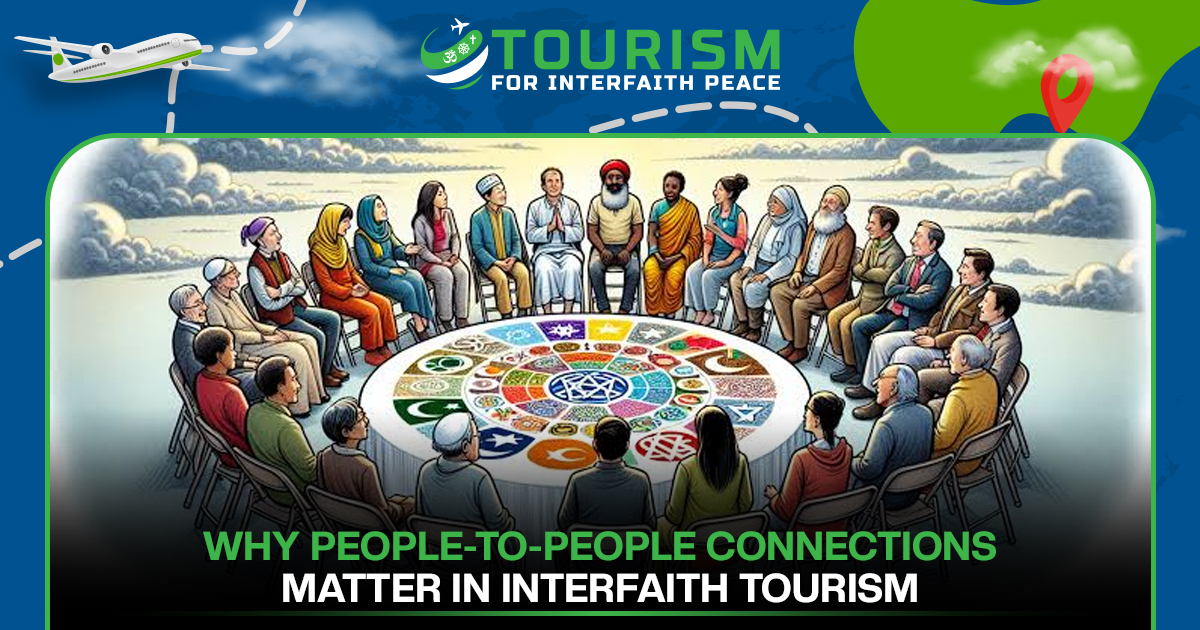
- Places create the setting for interfaith tourism, but people create the connection — conversations, shared meals and guided encounters build understanding that sightseeing alone cannot.
- Responsible interfaith tourism treats local communities as participants and beneficiaries, not backdrops, and depends on informed, respectful intermediaries such as local guides.
- Tourism cannot guarantee peace, but respectful, repeated human contact can reduce social distance and create real conditions for dialogue and mutual understanding.
A journey can introduce a traveler to a place, but it is human interaction that determines what they actually take away from it. Religious and cultural tourism can easily narrow into a checklist of monuments, rituals and destinations — a mosque photographed, a temple visited, a shrine checked off an itinerary. The deeper value of travel tends to emerge somewhere else: in conversation with a local resident, a shared meal with a host family, a question patiently answered by a guide, a festival witnessed alongside neighbors of another faith.
Interfaith tourism is strongest not when it moves travelers efficiently between sacred sites, but when it creates respectful human encounters along the way.
What Are People-to-People Connections in Tourism?
People-to-people connections are the direct human exchanges that occur between travelers and the communities they visit — not transactions, but conversations. They take many forms: a conversation with a shopkeeper near a shrine, a community-hosted meal, a guided walk through a heritage neighborhood, a craft demonstration by a local artisan, or a respectful invitation to observe a local festival.
What distinguishes these moments from ordinary sightseeing is reciprocity. Both traveler and host bring something to the exchange, and both leave a little changed by it. A traveler who photographs a monument alone will remember the architecture. A traveler who talks with the person who maintains it will remember a person.
Why Human Interaction Matters in Interfaith Tourism
It challenges stereotypes
Direct interaction replaces assumption with lived experience. Meeting one member of a faith community does not explain that community in full, but it can quietly dismantle a generalization a traveler arrived carrying.
It creates empathy
Listening to someone describe why a practice matters to them tends to build understanding in a way that reading about that practice from a distance rarely does.
It encourages mutual respect
Conversation reveals both genuine differences and unexpected common ground — a shared sense of humor, a shared concern for family, a shared instinct for hospitality.
It creates lasting memories
Long after a traveler forgets the dimensions of a courtyard, they tend to remember the person who welcomed them into it.
It builds trust
Repeated, respectful interaction — across many travelers and many visits — contributes to communities that have real reasons to see visitors as welcome rather than intrusive.
From Religious Sites to Shared Human Experiences
A monument can preserve history. A conversation can make that history human. A shrine or temple shows what a tradition looked like centuries ago; a resident, caretaker or fellow worshipper can explain what it still means today, in the present tense, to someone actually living it.
Site-based tourism moves a traveler through geography. Relationship-based tourism moves a traveler through understanding. The shift tends to follow a natural sequence — seeing a place, listening to the people connected to it, understanding why it matters to them, engaging with genuine questions, and, where welcomed, connecting on a more personal level. Not every visit reaches the final stage, and that is fine. Even reaching “listening” moves a trip beyond sightseeing.
The Role of Local Communities
Local communities are not backdrops for a travel experience; ideally, they are participants in it and beneficiaries of it. Community-hosted meals, family-run hospitality, local artisans, cultural practitioners and the caretakers of religious sites all carry knowledge that no itinerary can substitute.
Responsible interfaith tourism treats that knowledge, and the people who hold it, with the same respect it extends to any historic site: attention to dignity, privacy, consent, religious practice and the boundaries a community sets around its own spaces. A community that decides how it wants to be represented, rather than having that decided for it, is what makes people-to-people tourism sustainable rather than extractive.
How Shared Food, Stories, Art and Traditions Build Understanding
Cultural connection often happens through the most ordinary human experiences. A shared meal, a story told across generations, a piece of music, a handmade craft or a festival witnessed together tend to open conversation in ways formal dialogue rarely does. As TIP has explored elsewhere, shared food experiences can connect different faiths and cultures, and similar moments built around craft, music and storytelling create common ground between travelers and hosts without requiring anyone to set aside genuine differences. The goal is not to erase distinction. It is to find the places where distinct traditions can still meet.
The Role of Local Guides in Creating Meaningful Encounters
A guide’s choices — which detail to highlight, which question to answer patiently, which story to tell about a community’s history — shape what a traveler ultimately understands. A good guide functions less like a narrator of facts and more like a cultural interpreter: someone who can explain context, model respectful curiosity, gently correct a misconception, and create the kind of safe space in which a traveler feels able to ask an honest question.
This is why the role of local guides in promoting interfaith understanding matters as much as the sites themselves. People-to-people connections in tourism rarely happen without an informed intermediary making the first introduction possible.
Pakistan’s Potential for People-to-People Interfaith Tourism
Pakistan’s religious and cultural diversity offers unusually rich ground for this kind of travel. The country is home to significant Muslim, Christian, Hindu, Sikh and Buddhist heritage and communities, alongside distinct traditions such as the Kalash people of Chitral, each maintaining living practices connected to mosques, churches, temples, gurdwaras and ancient Buddhist sites along the Gandhara trail.
Pakistan’s religious festivals can also create opportunities for cultural harmony when travelers are able to witness them respectfully, offering some of the most visible moments where different communities share public space. But Pakistan’s potential is not only in its heritage sites. It is in the people connected to them — the caretaker at a shrine, the family that opens its home during a festival, the guide who has spent years learning how to introduce a tradition to someone encountering it for the first time. The strongest interfaith travel experiences tend to combine the place, its history, its people and its living traditions, rather than any one of these alone.
How People-to-People Tourism Can Support Peace
Tourism does not automatically create peace, and it would be a mistake to claim otherwise. What meaningful, person-to-person travel can do is more modest and still significant: it can reduce social distance between people who might otherwise never meet, encourage dialogue instead of assumption, and humanize communities that are often reduced to headlines or stereotypes elsewhere.
Each respectful interaction — a shared meal, an honest conversation, a festival witnessed together — can create conditions for further understanding, even though it cannot guarantee it. At scale, many such interactions, repeated across many travelers, have the potential to contribute to the kind of familiarity that makes coexistence feel less like an abstract ideal and more like a lived reality.
How Travelers Can Build Better Interfaith Connections
- Ask respectful questions, and accept that some questions may go unanswered.
- Listen more than you speak, especially in unfamiliar settings.
- Learn basic cultural and religious etiquette before visiting a site or community.
- Support locally owned businesses, guides and artisans connected to the community you’re visiting.
- Avoid treating religious practices or rituals as spectacles to be observed from a distance.
- Ask permission before photographing people, especially during active worship or ritual.
Choose informed, responsible interfaith travel practices and local guides over convenience alone.
- Stay open to perspectives that differ from your own, without needing to resolve or rank them.
The Future of People-to-People Interfaith Tourism
Interfaith tourism is likely to keep moving toward models that are more community-centered, more experiential and more participatory, where local voices shape how a place is represented rather than having that representation imposed from outside. Digital tools can help travelers discover destinations and prepare respectfully before they arrive, but they cannot replace the encounter itself. Technology can point the way to a conversation; it cannot have the conversation. That part will always depend on people willing to meet each other, in person, with curiosity and respect.
A Fair Conclusion
The most meaningful journey may not be the one that takes a traveler the farthest, but the one that helps them understand people they might otherwise never have known. People-to-people connections are what turn interfaith tourism from a sequence of destinations into something closer to what its name suggests: understanding built between people, one respectful encounter at a time.
That understanding tends to move through a familiar sequence — from curiosity to empathy, from empathy to respect, from respect to dialogue, and from dialogue to genuine connection. Tourism for Interfaith Peace exists to support exactly that kind of travel: journeys that leave both traveler and host a little more understood than before.
Frequently Asked Questions
What is people-to-people tourism?
People-to-people tourism is travel built around direct human interaction — conversations, shared meals, community-hosted experiences and guided encounters — rather than passive sightseeing. It treats connection with local residents and communities as central to the travel experience, not incidental to it.
Why are people-to-people connections important in interfaith tourism?
They turn a visit to a religious or cultural site into a genuine encounter with the people connected to it. A monument can show a traveler what a tradition looked like historically; a conversation with someone who still practices it can show what it means today.
How can tourism promote interfaith understanding?
Tourism promotes interfaith understanding when it creates respectful opportunities for travelers and communities of different faiths to meet directly — through shared meals, guided visits, festivals and everyday conversation — rather than limiting engagement to observing sites from a distance.
How can travelers respectfully interact with different faith communities?
By researching customs beforehand, dressing and behaving appropriately at religious sites, asking before photographing people or rituals, listening more than speaking, and following the guidance of local hosts or guides rather than assuming how to behave.
What role do local communities play in interfaith tourism?
Local communities are active participants and beneficiaries in interfaith tourism, not simply a backdrop for visitors. Their knowledge, hospitality and consent shape whether an experience is respectful and meaningful rather than extractive.
Can interfaith tourism contribute to peace?
It can contribute to the conditions that support peace — reduced social distance, humanized understanding of unfamiliar communities and ongoing dialogue — though tourism alone cannot guarantee peace. Its contribution depends on how respectfully and consistently that engagement happens.
Why is Pakistan suitable for interfaith cultural tourism?
Pakistan is home to significant Muslim, Christian, Hindu, Sikh and Buddhist heritage and communities, along with distinct traditions such as the Kalash people, giving travelers unusually concentrated opportunities to encounter diverse living faiths within a single journey.