- Interfaith travel benefits rural areas by funding heritage preservation, creating inclusive income for artisans and small businesses, and building genuine cross-cultural relationships between visitors and residents.
- It also gives rural youth and women new roles as guides, entrepreneurs, and cultural ambassadors, strengthening local pride in traditions that might otherwise go unrecorded.
- Done responsibly, it turns tourism into a tool for peacebuilding rather than just an economic transaction.
Many rural communities hold centuries-old religious traditions, sacred landscapes, and cultural practices that remain largely unknown outside their own region. A shrine tended by the same family for generations, a festival that draws pilgrims from more than one faith, an oral history passed down without ever being written — these are the kinds of living heritage that rarely make it into a guidebook. Interfaith travel changes that. It gives outside visitors a reason to learn about different beliefs firsthand, and it gives rural communities a reason, and often the means, to preserve what they already hold. Done thoughtfully, interfaith tourism becomes more than a niche travel category — it becomes a driver of peace, inclusion, and sustainable rural development.
Why Rural Areas Play an Important Role in Interfaith Tourism
Rural regions tend to hold the most authentic version of a living religious tradition, simply because urban development hasn’t reshaped the landscape around it. Sacred sites in rural areas are frequently still in active use rather than preserved as museum pieces, which gives visitors a different kind of experience — one shaped by community participation rather than curated presentation.
That authenticity comes with responsibility. Rural communities carry indigenous knowledge about their own sacred landscapes that no outside institution can replicate, and heritage preservation efforts succeed only when that local knowledge is treated as central, not supplementary.
Interfaith Travel Builds Stronger Community Relationships
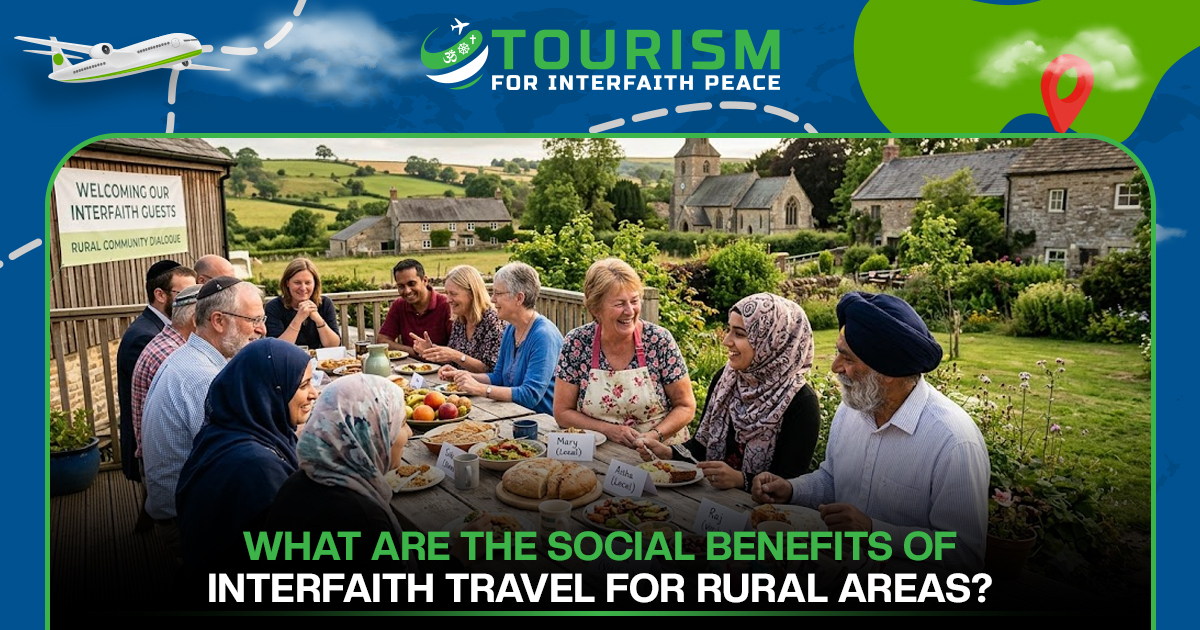
The most lasting benefit of interfaith travel is rarely economic — it’s relational. Genuine cultural exchange happens when a visitor and a resident share a meal, a conversation, or a moment of quiet observation at a sacred site, and that kind of direct contact tends to dismantle stereotypes faster than any awareness campaign.
Mutual respect isn’t automatic, though. It’s built through dialogue, and interfaith tourism creates the setting for that dialogue to happen organically — visitor and host each bringing their own understanding of shared human values, and each leaving with a slightly wider one. That’s peacebuilding in its most practical form: not a formal negotiation, but repeated, respectful human interaction.
Supporting Local Economies Beyond Tourism Revenue
The economic case for interfaith tourism goes well beyond ticket sales or hotel bookings. It reaches artisans producing traditional crafts, family-owned guesthouses, farmers and food producers supplying local kitchens, and increasingly, women’s enterprises and youth-run ventures that wouldn’t otherwise have a customer base. This is one of the clearer economic opportunities created by interfaith tourism — spending that’s distributed across many small local operators instead of concentrated in a handful of large properties, which is exactly the kind of inclusive economic model rural development strategy tends to favor.
Preserving Religious and Cultural Heritage for Future Generations
Visitor interest creates a direct, practical argument for restoration and upkeep. Sacred architecture, oral traditions, and traditional festivals all require resources to maintain, and heritage sites with steady, respectful visitor traffic are simply more likely to secure that funding than sites nobody outside the community ever sees.
There’s a less tangible benefit too: community pride. When outsiders travel specifically to witness a tradition a community has quietly maintained for generations, it reframes that tradition as something worth documenting and passing on, rather than something assumed to fade with time.
Encouraging Youth to Become Cultural Ambassadors
Rural youth are often the generation most at risk of disconnecting from local heritage, drawn toward urban opportunity or digital culture that has little to do with their own community’s traditions. Interfaith tourism offers an alternative path — one where youth engagement matters for interfaith tourism becomes obvious in practice. Young people trained as guides, storytellers, or digital content creators around a heritage site aren’t just earning an income — they’re becoming the ones responsible for how that heritage gets explained to the outside world, which builds a different kind of ownership over it.
Women Are Strengthening Rural Interfaith Tourism
Craft markets, homestays, and hospitality roles connected to interfaith tourism are frequently where rural women access their first formal income opportunities in otherwise limited local job markets. That’s a pattern worth naming directly: how women travelers are shaping interfaith tourism is only half the story — women are just as often shaping it from the host side, as entrepreneurs, cultural custodians, and local leaders whose enterprises anchor a more inclusive tourism economy.
Responsible Interfaith Travel Creates Long-Term Social Value
None of these benefits happen automatically. Responsible interfaith travel depends on visitors approaching sacred spaces with cultural sensitivity, on tour operators sharing revenue fairly with the communities hosting them, and on environmental responsibility that protects the landscapes tied to these traditions in the first place.
Shared responsibility is the operative phrase. Long-term social value comes from tourism that treats community participation as a requirement, not an afterthought — communities helping shape how their own heritage is presented, rather than having that presentation decided elsewhere.
Why Tourism for Interfaith and Peace (TIP) Supports Community-Centered Tourism
TIP works from the premise that tourism should strengthen the communities it touches, not simply pass through them. That means promoting intercultural dialogue as a genuine goal rather than a marketing angle, protecting religious heritage sites in partnership with the communities that steward them, and encouraging the kind of responsible travel that measures success by community benefit as much as visitor numbers. Supporting community participation and preserving cultural diversity aren’t separate initiatives from that mission — they’re the mechanism through which it actually happens on the ground.
Conclusion
The true value of interfaith travel extends far beyond visiting sacred places. Every respectful journey into a rural community creates opportunities for understanding, heritage preservation, economic inclusion, and lasting human connection — the kind that doesn’t end when the visit does. At its best, tourism becomes a bridge between cultures, faiths, and communities, helping build a more peaceful and inclusive world one meaningful journey at a time.