1. Introduction: When a Door Opens, the World Shifts
There is a particular kind of silence that falls just before a shared meal in a stranger’s home — a pause in which two people, separated by language, faith, and geography, recognize something unmistakably human in one another. It is in that silence that the real work of travel begins.
Across the world, as geopolitical tensions rise and cultural narratives harden, a quiet movement is growing — one in which travelers are choosing to move not through airports and hotel lobbies, but through living rooms, kitchens, and sacred spaces of ordinary families. This movement has a name: interfaith tourism. And in few places on earth does it find more fertile ground than in Pakistan.
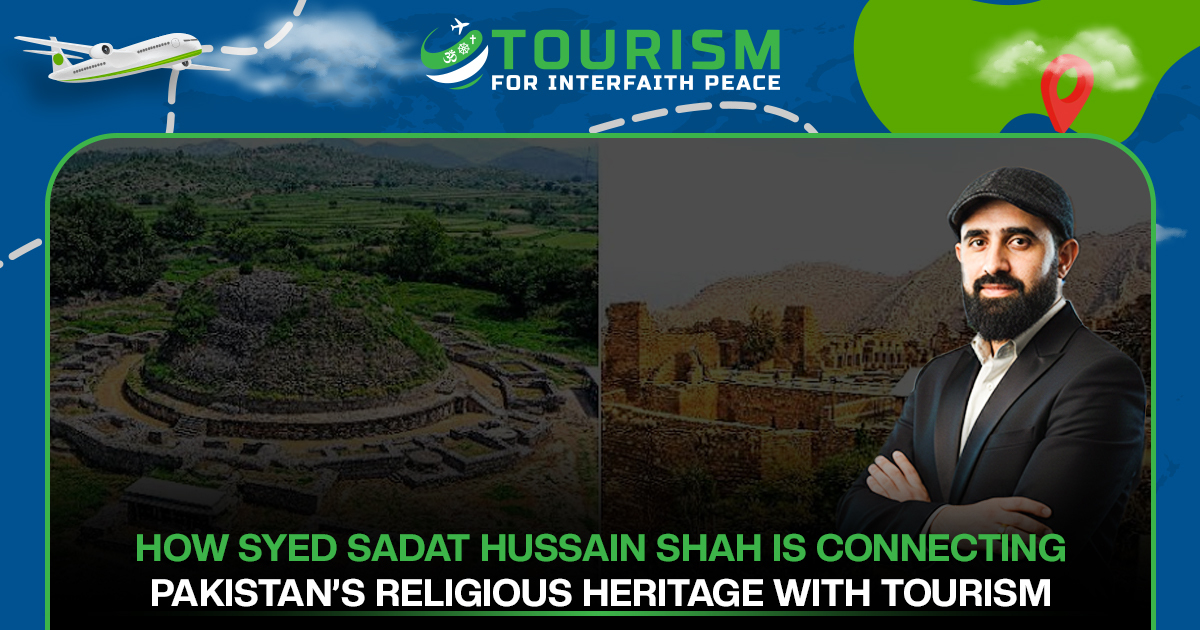
Pakistan is a country of astonishing spiritual diversity. From the ancient stupas of Taxila to the Gurdwaras of Lahore, from the Sufi shrines of Sindh to the Hindu temples of Karachi, the country holds within its geography a tapestry of civilizations, traditions, and faiths that few destinations can rival. Yet for much of the international travelling public, Pakistan remains unknown — an unfair absence rooted in stereotype rather than reality.
Homestays offer the most direct remedy to that absence. When a traveller sleeps under the same roof as a Pakistani family, shares their bread, listens to their stories, and witnesses how faith is woven quietly into daily life, no amount of media portrayal can compete. The experience speaks for itself.
This article explores how interfaith homestays in Pakistan are reshaping the way the world understands this remarkable country — and how they are quietly, powerfully building the bridges that peace requires.
“Travel is not just movement. At its deepest, it is an act of trust — the willingness to be changed by what we encounter.”
2. What Is Interfaith Tourism?
Interfaith tourism is a purposeful form of travel that places religious heritage, cultural diversity, and cross-community understanding at the heart of the journey. Unlike conventional sightseeing, it is not primarily about monuments or landscapes — it is about people, practices, and the shared human search for meaning.
At its core, interfaith tourism invites travellers to engage respectfully with faith traditions different from their own: visiting places of worship, participating in community rituals when welcomed, learning from religious leaders and ordinary families alike, and witnessing how diverse beliefs can coexist within a shared civic and natural landscape.
The purpose of interfaith tourism is threefold: to build personal understanding, to challenge inherited prejudice, and to foster the kind of human connection that political processes alone cannot achieve. As explored in depth on this platform’s guide to what interfaith tourism means and how it promotes global peace, this form of travel is increasingly recognised by scholars, peacebuilders, and UNESCO as a meaningful instrument of cultural diplomacy.
Pakistan’s role in this global movement is significant. As a country that hosts the world’s second-largest Buddhist heritage site, one of the most important Sikh pilgrimage circuits on earth, ancient Hindu temples, vibrant Sufi traditions, and the majority of the world’s Ismaili Muslim community, Pakistan is — objectively — one of the most spiritually layered travel destinations in the world.
3. Why Homestays Matter in Interfaith Travel
A hotel is a transaction. A homestay is a relationship.
That distinction, simple as it sounds, carries enormous weight when the goal of travel is genuine cultural understanding. In a hotel, the traveller remains a guest of an institution. In a homestay, they become a temporary member of a family — subject to its rhythms, its customs, its kindnesses, and its contradictions.
For interfaith travellers, this distinction is everything. Cultural immersion — the kind that actually changes how we see the world — does not happen through curated tours or museum displays. It happens when the family’s grandmother teaches you how to roll roti. When the call to prayer wakes you at dawn and your host explains, unhurriedly, what those words mean to him. When the children of a Hindu family in Lahore walk you through the small shrine in their courtyard and speak about devotion with the unselfconscious ease of those for whom faith is simply part of breathing.
Hotels, however comfortable, create distance. Homestays collapse it.
Breaking Stereotypes Through Lived Experience
One of the most persistent barriers to interfaith understanding is the power of abstract narrative over lived experience. For many international travellers, Pakistan exists as an idea shaped by news cycles and geopolitical discourse rather than as a place of welcoming families, extraordinary landscapes, and centuries of coexisting faiths.
A single week in a Pakistani home dismantles more stereotypes than a decade of documentary viewing. The traveller who has shared sehri with a fasting family during Ramadan, or attended a Sufi qawwali evening in the courtyard of a village home, or been guided through a Sikh Gurdwara by a Muslim neighbour who visits it out of simple neighbourly respect — that traveller returns home carrying a truth that no prejudice can easily unseat.
4. How Homestays Build Religious and Cultural Understanding
The mechanisms through which interfaith homestays build understanding are both intimate and profound. They operate not through lectures or formal programmes, but through the quiet accumulation of shared moments.
Shared Meals and the Language of Hospitality
Pakistani hospitality — mehmaan-nawazi — is not a cultural nicety. It is a deeply held ethic that runs across all of the country’s faith communities. Whether the host family is Muslim, Christian, Hindu, or Sikh, the imperative to welcome a guest with generosity is near-universal.
Food, accordingly, becomes the first and most immediate classroom. The traveller who eats with a family learns which foods are sacred, which are shared at celebration, which mark mourning. They learn how dietary practice reflects belief — and how, across different faiths in Pakistan, the table is consistently a place of inclusion rather than exclusion.
Storytelling, Heritage, and the Living Memory of Place
Pakistani families carry extraordinary oral histories. In regions like Gilgit-Baltistan, the Swat Valley, or the Cholistan Desert, families can speak to centuries of local religious life: the Buddhist monasteries that once lined their valley, the Sikh merchants who traded through their town, the Sufi saints whose shrines still anchor their social life. This living memory, passed down through generations, offers a richness that no textbook can replicate.
Homestays unlock this archive. Travellers who stay with local families gain access to a layered, nuanced, often surprising account of religious coexistence — one in which complexity is not smoothed away, but preserved in its full human texture.
Witnessing Faith in Its Natural Habitat
There is a profound difference between observing religious practice in a museum or a formal ceremony, and witnessing it in the flow of ordinary life. In a Pakistani home, faith is not performed for visitors — it is lived. The traveller may observe the quiet ritual of morning prayer, the careful preparation of food according to religious custom, the spontaneous reverence of a family member at a roadside shrine.
These unscripted moments are, for many travellers, the most transformative of their journey. They encounter religion not as doctrine or institution, but as something woven into the fabric of daily life — and in doing so, they often find unexpected resonance with their own spiritual traditions.
“In a Pakistani home, faith is not performed for visitors — it is lived. And that, for the traveller, changes everything.”
5. Pakistan as an Emerging Interfaith Tourism Destination
Pakistan’s credentials as an interfaith tourism destination are extraordinary — and remain dramatically underappreciated by the global travel community.
A Landscape of Ancient Faiths
- Gandhara — the ancient Buddhist civilisation centred on modern-day Khyber Pakhtunkhwa and Punjab — produced some of the finest Buddhist art and philosophy in human history. Taxila, a UNESCO World Heritage Site, remains one of the most important Buddhist archaeological complexes in the world.
- The Sikh faith was born in the Punjab region, much of which now lies within Pakistan. Nankana Sahib, the birthplace of Guru Nanak, and Kartarpur — site of the historic Kartarpur Corridor — draw thousands of Sikh pilgrims annually.
- Pakistan is home to some of South Asia’s most ancient Hindu temples, including Katas Raj in Punjab, where the sacred pool is believed to have formed from the tears of Lord Shiva.
- Sufi Islam, with its emphasis on love, music, and the direct experience of the divine, has shaped Pakistani culture across centuries. The shrines of Data Ganj Bakhsh in Lahore, Shah Abdul Latif Bhittai in Sindh, and Lal Shahbaz Qalandar in Sehwan are living centres of spiritual life.
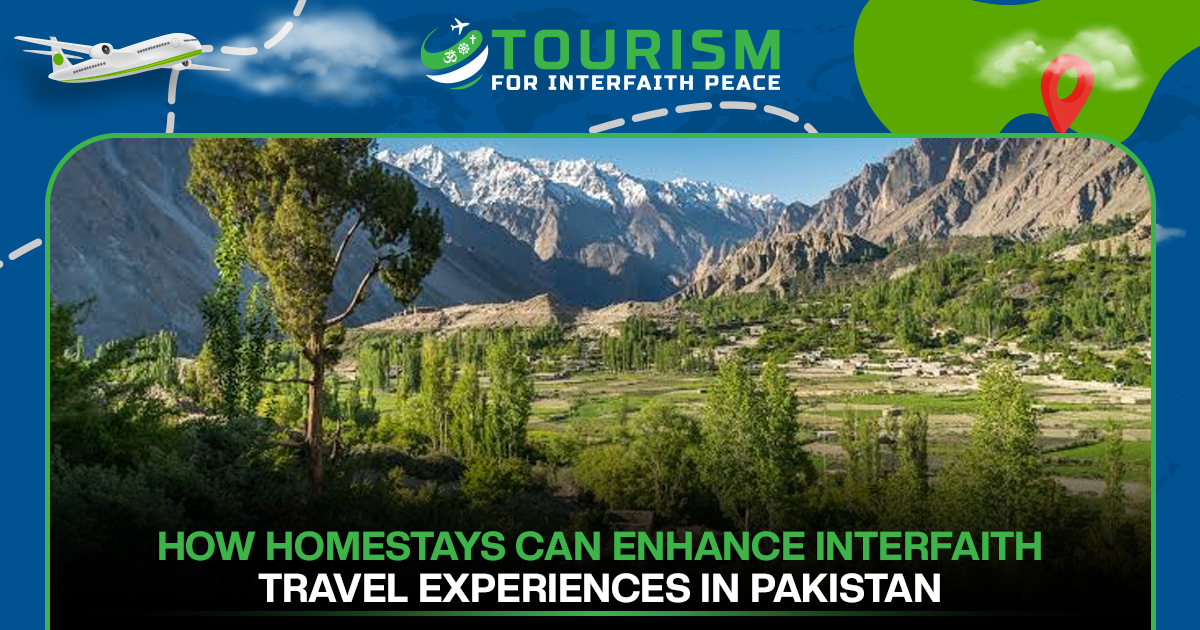
- Pakistan is home to the world’s largest Ismaili Muslim community, largely concentrated in the magnificent Gilgit-Baltistan region — whose mountain landscapes add an additional dimension of awe to any spiritual journey.
For travellers seeking to explore this remarkable heritage in depth, our guide to the best interfaith travel destinations in Pakistan provides a region-by-region overview of where cultural understanding and peacebuilding can most powerfully intersect.
A Culture of Welcome
Beyond the monuments and heritage sites, Pakistan’s most powerful interfaith tourism asset is its people. Pakistani hospitality is legendary — and it is not reserved for those of a particular faith or background. The visitor who arrives openly and respectfully is almost universally received with warmth, curiosity, and generosity.
Community-based homestay programmes formalise this natural hospitality into a sustainable tourism model — one that benefits hosts and guests equally, and that positions Pakistan’s greatest asset not in its ancient stones, but in its living communities.
6. Benefits for Travellers and Local Communities
Economic Empowerment at the Grassroots
Unlike large hotel chains or international tour operators, homestay programmes direct the economic benefit of tourism directly into the hands of local families. In regions where formal employment is limited — particularly in rural Punjab, Sindh, or the mountain communities of the north — homestay income can provide meaningful financial stability while preserving the family’s connection to their land and cultural identity.
Women, in particular, often play a central role in homestay operations — managing household logistics, preparing food, and hosting guests — gaining both income and a dignified form of economic agency within their community context.
Cultural Preservation Through Living Practice
When communities can generate income from their cultural and religious heritage, they have a powerful incentive to preserve it. Homestay tourism creates an economic logic for maintaining traditional crafts, culinary practices, oral histories, and ritual knowledge that might otherwise be lost to urbanisation and globalisation.
In this sense, the interfaith traveller becomes not merely a consumer of culture, but an inadvertent patron of its preservation.
Youth Engagement and Cross-Cultural Literacy
Young Pakistanis who grow up hosting international travellers develop something rare and valuable: genuine cross-cultural literacy. They learn to see their own traditions through curious, respectful outside eyes — and to explain, articulate, and take pride in a heritage that urban modernity sometimes teaches them to regard as old-fashioned.
For international travellers — particularly young people — the homestay experience plants seeds of understanding that may grow, over a lifetime, into advocacy, solidarity, and the kind of informed global citizenship that peace actually requires.
Cross-Cultural Peace Building
Perhaps most significantly, interfaith homestay tourism contributes to peace in the most organic way imaginable: by making it personal. As we explore in our article on how cultural experiences foster peace and understanding in tourism, the human relationships formed through travel have a capacity to transcend political and religious division that few other mechanisms can match.
The traveller who has been a guest in a Pakistani home does not abstract Pakistan. They remember a specific family, a specific meal, a specific conversation. And that specificity is what makes peace durable.
7. Challenges and Ethical Considerations
Authentic interfaith travel demands more than curiosity — it demands responsibility. Travellers who engage with communities whose faith and cultural practices differ from their own carry an obligation to do so with care, humility, and awareness.
Respecting Local Customs and Sacred Spaces
In Pakistan, as in any deeply faith-infused culture, certain customs are not negotiable: dress codes in places of worship, gender-specific behavioural norms in some communities, the sanctity of prayer times, and the protocol around sacred objects and spaces. Homestay travellers who invest time in understanding these conventions before arrival — and who approach their hosts with genuine questions rather than assumptions — are invariably welcomed more warmly and gain far deeper insight.
Responsible Tourism: Beyond Good Intentions
Ethical interfaith travel also means attending to the structural dynamics of tourism itself. It means choosing operators and platforms that return fair compensation to host communities, that do not commodify sacred practice as entertainment, and that involve local communities in shaping the terms of their own representation. Our guide to responsible interfaith tourism offers practical frameworks for travellers who wish to ensure their presence contributes positively to the communities they visit.
Avoiding Cultural Exploitation
There is a fine line between cultural appreciation and cultural exploitation — and interfaith travel, because of its intimate nature, requires travellers to be especially attentive to that line. Photographing private religious moments without consent, sharing host family details in public forums, or treating sacred spaces as photogenic backdrops all represent failures of the ethical compact that homestay travel requires.
The rule is simple, if not always easy: the community’s dignity comes before the traveller’s experience.
8. The Future of Interfaith Homestay Tourism in Pakistan
The conditions for the growth of interfaith homestay tourism in Pakistan are more favourable now than at any previous point in modern history.
Sustainable Tourism Growth
Pakistan’s tourism sector has experienced significant expansion in recent years, driven by improved infrastructure, a growing domestic travel culture, and a global rise in interest in off-the-beaten-path destinations. Interfaith homestay tourism is positioned to benefit from all three — offering a form of travel that is, by design, sustainable: small in scale, community-rooted, and light in its footprint.
Digital Platforms and Global Connectivity
The rise of community-based travel platforms, social media storytelling, and digital booking systems has dramatically lowered the barrier to entry for international visitors seeking homestay experiences in Pakistan. Platforms dedicated to interfaith and cultural travel are increasingly visible to global audiences who are actively searching for meaningful alternatives to mass tourism.
As more Pakistani families join verified homestay networks — and as international travellers share their experiences through trusted channels — the ecosystem will continue to grow, reinforcing itself through the most powerful form of marketing available: genuine human testimony.
Global Awareness and Narrative Shift
Perhaps the most significant development is a quiet but perceptible shift in how Pakistan is perceived internationally. Travellers who have visited are increasingly vocal advocates for the country’s beauty, hospitality, and cultural richness. Journalists, travel writers, and documentary filmmakers are returning with stories that challenge and complicate the simplistic narratives that long dominated international coverage.
Interfaith homestay tourism is both a product of this shift and a driver of it. Every traveller who returns home transformed by their experience becomes an ambassador for a more nuanced, more honest understanding of Pakistan’s place in the world.
9. Frequently Asked Questions
What is interfaith tourism?
Interfaith tourism is a purposeful form of travel that centres engagement with diverse religious traditions, sacred sites, and faith communities. Its goal is not pilgrimage to one’s own religion, but respectful exploration of the beliefs and practices of others — building understanding, challenging stereotypes, and fostering cross-cultural connection. It is increasingly recognised as a meaningful instrument of cultural diplomacy and peacebuilding.
Are interfaith homestays in Pakistan safe for international travellers?
Yes — when arranged through reputable, community-verified programmes and approached with appropriate cultural preparation, interfaith homestays in Pakistan are safe and deeply rewarding for international visitors. Pakistan has a long tradition of extending extraordinary hospitality to guests from all backgrounds. Travellers are advised to work with established local partners, carry appropriate documentation, follow standard safe travel protocols, and consult their government’s current travel advisories before departure.
How do homestays promote cultural understanding?
Homestays promote cultural understanding by placing travellers in the daily life of a local family — exposing them to lived religious practice, food customs, family values, and oral histories that no hotel stay or guided tour can replicate. The result is an experience of culture as something lived and embodied, rather than observed from a distance — and this shift in perspective is the most direct pathway to genuine cross-cultural empathy.
Which regions in Pakistan are best for interfaith tourism?
Pakistan offers remarkable interfaith heritage across multiple regions. Taxila and the Swat Valley are essential for Buddhist heritage. Lahore and Nankana Sahib are central to Sikh pilgrimage. Katas Raj and Hinglaj in Balochistan are sacred Hindu sites. The shrines of Sindh — particularly those of Shah Abdul Latif Bhittai and Lal Shahbaz Qalandar — offer unparalleled insight into Sufi tradition. Gilgit-Baltistan combines Ismaili heritage with spectacular mountain landscapes. Each region offers its own distinct interfaith character.
What should interfaith travellers know before staying in a Pakistani homestay?
Travellers should familiarise themselves with basic Pakistani cultural courtesies: modest dress is appreciated across all regions; shoes are typically removed before entering homes; the right hand is used for eating and giving/receiving; and questions about faith, asked with genuine curiosity and humility, are generally welcomed. Learning a few words of Urdu is a gesture that hosts invariably appreciate. Most importantly, approach the experience with openness — the willingness to be surprised is perhaps the most important thing a traveller can bring.
How does interfaith homestay tourism benefit local communities in Pakistan?
Interfaith homestay tourism provides direct economic benefit to host families — particularly in rural and historically under-visited regions. It creates incentives for the preservation of cultural and religious heritage. It engages young people in cross-cultural exchange that builds confidence and global literacy. And it contributes to Pakistan’s growing reputation as a welcoming, culturally rich destination — which benefits the wider tourism economy and helps reshape international narratives about the country.
10. Conclusion: Peace Is Personal
There is a question that every traveller carries, whether or not they are conscious of it: What is the world actually like? Not the world of headlines and abstractions, but the world of real people, living real lives, shaped by real faiths and real histories?
Interfaith homestays in Pakistan offer one of the most honest, most moving, and most enduring answers to that question available anywhere on earth.
When you stay with a Pakistani family — when you wake to the sound of azaan and share a meal of warm chapati and sweet chai before a day spent walking among ancient stupas or Sufi shrines — you are not merely a traveller. You are, in the most literal sense, building peace. Not the peace of political agreements or international declarations, but the peace that takes root in individual hearts and changes, slowly and irreversibly, how we see one another.
Pakistan has been waiting for this kind of traveller. Its families are ready to open their doors. Its heritage is ready to be witnessed. Its stories are ready to be heard.
The question is simply whether you are ready to arrive.
“Every family that opens its home, and every traveller who enters with an open heart, is writing a small chapter of a larger story — the story of a world learning, slowly, to know itself.”