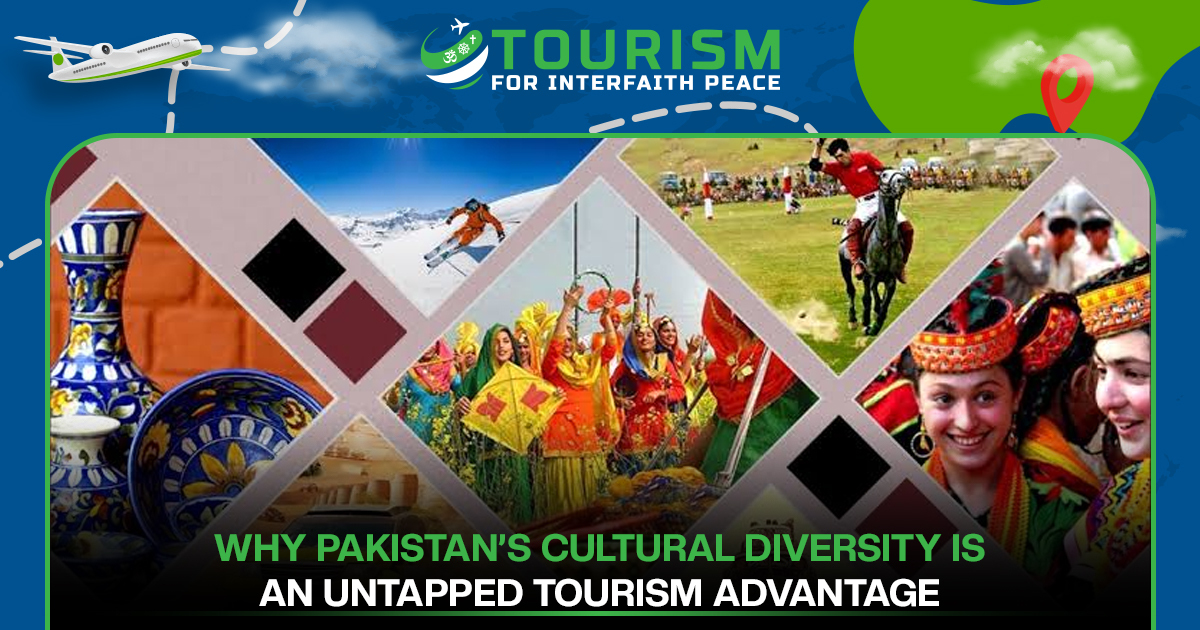
- Pakistan’s regional, linguistic, religious, and historical diversity is a tourism asset in its own right, not just a backdrop to natural scenery.
- The country holds six UNESCO World Heritage Sites, including Mohenjo-daro, Taxila, and the Lahore Fort and Shalamar Gardens, with 26 more sites on its UNESCO tentative list.
- Cultural and heritage tourism creates work for guides, artisans, hospitality staff, and small local businesses, while giving communities a direct stake in preserving what makes a place distinctive.
- Interfaith and heritage tourism can build understanding between communities when it is approached with respect, without turning religious sites into performances for visitors.
- Tourism for Interfaith Peace (TIP) approaches tourism as a way of connecting cultures, communities, and faiths, built on the same community-first principles that shape how a destination should be developed.
Pakistan’s diversity is usually described in cultural terms — different languages, faiths, and regional traditions living alongside one another. What gets discussed less often is that this same diversity is a genuine tourism advantage, one that few countries in the region can match in range. A visitor can move from the archaeological ruins of Mohenjo-daro to the Buddhist heritage of Taxila, from Sufi shrines to mountain valleys with their own distinct languages and craft traditions, within a single country. Turning that range into a tourism strength takes more than recognizing it exists; it takes deliberate storytelling, preservation, and community involvement.
Pakistan’s Cultural Diversity Is a Tourism Opportunity
Few countries pack as much regional variation into one national border. Punjab’s Mughal-era forts and gardens, Sindh’s Indus Valley archaeology, Khyber Pakhtunkhwa’s Gandhara Buddhist sites, Balochistan’s Karez irrigation heritage, and the mountain cultures of Gilgit-Baltistan each carry a distinct history, cuisine, architectural style, and set of languages. Pakistan is home to six UNESCO World Heritage Sites, all cultural in nature: the Archaeological Ruins at Moenjodaro, the Buddhist Ruins of Takht-i-Bahi, Taxila, the Fort and Shalamar Gardens in Lahore, the Historical Monuments at Makli in Thatta, and Rohtas Fort. A further 26 sites sit on the country’s UNESCO tentative list, an indication of how much heritage remains to be formally recognized and developed for visitors.
That range is exactly what cultural tourism depends on. A destination built around a single attraction has a ceiling; a country with dozens of distinct regional identities has room for entirely different itineraries built around history, faith, craft, or landscape, each appealing to a different kind of traveler.
From Religious Diversity to Interfaith Tourism
Pakistan’s religious history runs deeper than its present-day demographics suggest. Buddhist stupas in the north, Hindu temples and shrines across the country, Sikh gurdwaras including sites central to Sikh history, and a wide spectrum of Islamic tradition, from Sufi shrines to grand Mughal mosques, all sit within its borders. For visitors, engaging with that heritage respectfully, as a place of significance to the communities connected to it, rather than as a curiosity, is what separates interfaith tourism from sightseeing.
Interfaith tourism, done responsibly, gives travelers a reason to understand a community’s history and practices on its own terms. It does not require comparing traditions against one another; it asks visitors to approach each site with the same respect a community member would expect for their own place of worship. That distinction, treating heritage as living and significant rather than as a backdrop, is central to how tourism can genuinely build understanding between communities instead of simply moving people through a checklist of landmarks.
How Cultural Tourism Benefits Local Communities
Cultural tourism’s economic reach extends well beyond ticket sales at a heritage site. It supports:
- Local guides who bring context and history that a plaque or brochure cannot
- Artisans and craftspeople producing textiles, pottery, woodwork, and other traditional goods for visitor demand
- Small hospitality businesses, guesthouses, restaurants, and homestays, built around a specific region’s character
- Transport operators connecting heritage sites that are often outside major urban centers
- Preservation and restoration work, which itself creates skilled local employment
This pattern mirrors what tourism research consistently shows: when visitor spending reaches locally owned businesses directly, more of that value stays in the community rather than flowing to outside operators. It is the same principle discussed at greater length in
why tourism development should begin with local communities, and it applies just as directly to cultural and heritage tourism as to any other form of destination growth.
Why Community Participation Matters
Cultural heritage does not preserve itself, and it is not owned by the tourism industry that markets it. The people who live alongside a shrine, a fort, or a craft tradition are its custodians, and decisions about how that heritage is presented to visitors work best when those communities are involved from the outset rather than consulted after a plan is already set.
Left unmanaged, cultural tourism risks flattening a living tradition into a simplified performance staged for cameras. Community participation is what keeps a destination’s culture recognizable to the people who hold it, even as it becomes more visible to outside visitors. That is also where preservation and tourism growth reinforce each other: a community with a genuine economic stake in its own heritage has a stronger reason to protect it.
Building New Destinations Through Culture and Hospitality
A heritage site alone does not make a destination. Visitors need somewhere to stay, eat, and move between attractions, which is where hospitality and real estate planning intersect with cultural tourism. A well-preserved fort or shrine with no nearby accommodation, transport, or dining options struggles to hold visitors beyond a short visit; a region that plans hospitality and infrastructure around its cultural assets can turn a single landmark into a multi-day itinerary. How hospitality and real estate can work together to develop new destinations explores this relationship in more detail, and the same logic applies directly to cultural and heritage-driven destinations: culture gives visitors a reason to come, and hospitality gives them a reason to stay longer.
| Cultural Asset | What It Offers Visitors | Community and Economic Benefit |
|---|---|---|
| Archaeological and heritage sites | History, architecture, and a tangible connection to the past | Guiding, preservation work, and site-adjacent hospitality |
| Religious and interfaith heritage | Understanding of diverse faiths and communities | Respectful, community-led visitor programs and local stewardship |
| Regional crafts and cuisine | Distinct, place-specific experiences | Direct income for artisans, cooks, and small producers |
| Living regional traditions | Authentic cultural exchange | Recognition and continuity for traditions that might otherwise fade |
Pakistan’s Opportunity for Responsible Tourism Growth
Realizing this potential depends on a few consistent factors: better storytelling that gives visitors context before and during a visit, continued preservation of sites that remain underfunded relative to their significance, improved physical accessibility to heritage locations outside major cities, hospitality infrastructure built around each region’s character rather than a generic template, and community participation at every stage of planning rather than as an afterthought.
None of this happens through visitor numbers alone. A destination can see growing footfall and still fail its own communities if the economic and cultural value of that growth does not reach the people who make the destination worth visiting in the first place. Responsible tourism growth treats that outcome as the measure of success, not visitor counts on their own.
Conclusion
Pakistan’s cultural diversity, its regional traditions, its religious heritage, its languages and crafts, is not a secondary feature of its tourism potential. It is one of the country’s most distinctive assets, and one that, developed responsibly, can create employment, support small businesses, preserve heritage under real threat of neglect, and build genuine understanding between communities and faiths. Realizing that potential requires the same discipline any sustainable destination depends on: planning that starts with communities, preserves what makes a place distinctive, and gives visitors a reason to engage with culture rather than simply observe it.
Readers interested in how tourism can serve as a bridge between cultures, communities, and faiths can explore why tourism development should begin with local communities and how hospitality and real estate can work together to develop new destinations to see how these principles connect to broader destination development, or reach out to Tourism for Interfaith Peace directly to learn more about responsible, community-centered, peace-oriented tourism in Pakistan.
Frequently Asked Questions
Why is Pakistan’s cultural diversity a tourism advantage?
Pakistan combines regional traditions, languages, cuisines, and religious heritage across a single country, giving it the range to support many different kinds of cultural itineraries rather than a single attraction. That range, developed responsibly, is what distinguishes a country’s tourism offering over the long term.
How many UNESCO World Heritage Sites does Pakistan have?
Pakistan has six UNESCO World Heritage Sites, all cultural: the Archaeological Ruins at Moenjodaro, the Buddhist Ruins of Takht-i-Bahi, Taxila, the Fort and Shalamar Gardens in Lahore, the Historical Monuments at Makli, and Rohtas Fort. A further 26 sites are on the country’s UNESCO tentative list.
What is interfaith tourism?
Interfaith tourism involves visiting and engaging with sites and traditions connected to different faiths in a way that builds understanding and respect, treating each site as significant to the community connected to it rather than as a curiosity.
How does cultural tourism benefit local communities in Pakistan?
Cultural tourism supports local guides, artisans, small hospitality businesses, and transport operators, and can fund preservation work that protects heritage sites. Communities benefit most when tourism planning includes them from the outset rather than treating their involvement as an afterthought.
What role does Tourism for Interfaith Peace play in cultural tourism?
Tourism for Interfaith Peace approaches tourism as a way of connecting cultures, communities, and faiths, built on the principle that tourism development should begin with and benefit local communities rather than treat them as a backdrop for visitors.