There are cities that speak loudly of their past—and then there are cities like Sialkot, where history lingers in quieter ways: in carved stone, in weathered courtyards, in prayers that have echoed across centuries without ever asking to be compared. In the narrow lanes and open squares of this ancient Punjab city, faith has never been a singular story. It has been a shared rhythm.
Sialkot is not a place of spectacle; it is a place of continuity. A city where temples, gurdwaras, and mosques do not compete for space in memory, but coexist in layers of lived experience. To walk through it as an interfaith traveler is to step into a dialogue that never fully ended—only softened with time.
What does it mean to travel through sacred geography without reducing it to architecture alone? Can a journey become a form of listening? And what if the most important heritage of all is not stone, but coexistence itself?
This is where interfaith tourism finds its deepest meaning.
Sialkot – A City Where Faiths Have Coexisted Through Time
Sialkot’s cultural identity is shaped by centuries of movement—of ideas, pilgrims, artisans, scholars, and merchants who passed through its markets and settled its neighborhoods. Before modern borders redefined South Asia, Punjab was a continuum of shared sacred landscapes.
Also Read: How to Plan an Interfaith Cultural Tour in Hyderabad, Pakistan
The city’s religious fabric reflects this layered history. Hindu traditions left behind temples and ritual spaces. Sikh heritage remains embedded in gurdwaras tied to pilgrimage memory. Islamic influence shaped mosques, educational institutions, and civic life that continues today. Each tradition did not erase the other—it added a new voice to an already evolving conversation.
What happens when a city becomes a living archive of multiple faiths?
Can heritage survive political rupture and still remain spiritually intact?
And how do communities learn to read the past without resentment?
In Sialkot, these questions do not find perfect answers—but they remain visible in stone and story.
Sacred Hindu Heritage Sites in Sialkot
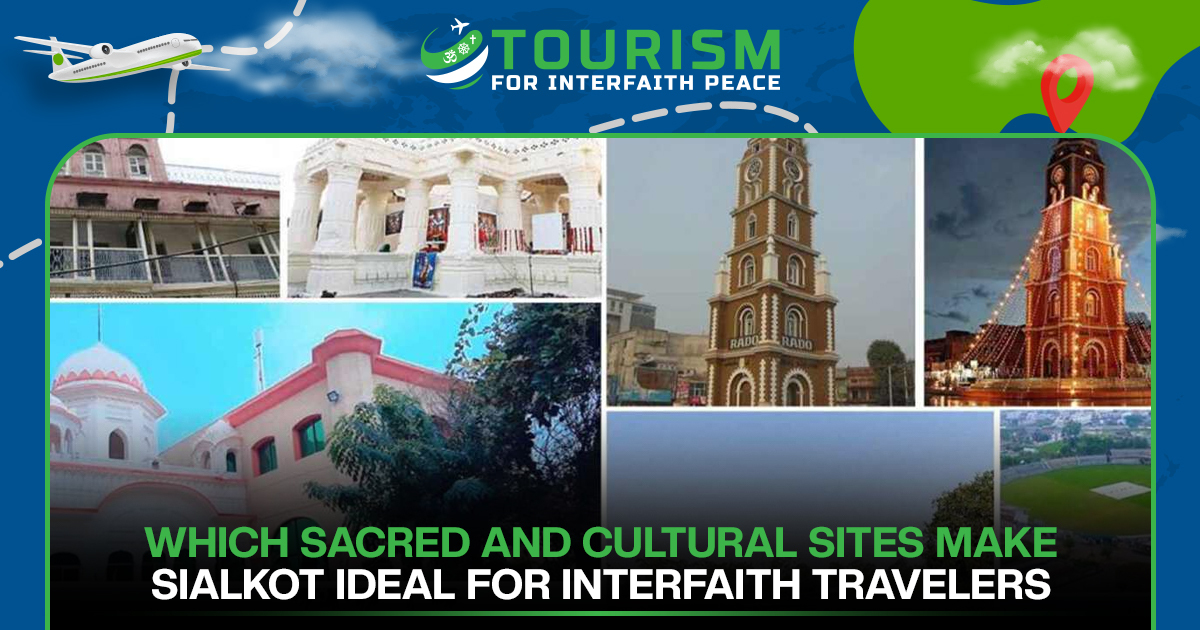
Among the most significant reminders of Sialkot’s plural past is the Shivala Teja Singh Temple, a Hindu temple that stands as both architectural heritage and cultural memory.
Once a vibrant center of worship, the temple reflects the artistic and spiritual traditions that once flourished across the region. Its design—marked by intricate carvings and symbolic detailing—speaks to a time when sacred spaces were deeply integrated into everyday civic life.
Also Read: What Religious Diversity Can Tourists Discover in Quetta?
Though many Hindu temples in Sialkot now exist more as heritage sites than active places of worship, their presence remains powerful. Efforts toward preservation and awareness have gradually reframed them not as remnants of absence, but as markers of resilience.
“A temple is not only a place of worship—it is a memory carved into stone.”
“Heritage survives even when rituals pause.”
What does it mean to preserve a sacred space when its original community has largely moved elsewhere?
Is restoration an act of architecture—or an act of remembrance?
And can silence itself be a form of spiritual continuity?
In Sialkot, these temples ask visitors to slow down and listen differently.
Sikh Spiritual Landmarks and Living Memory
Sikh heritage in Sialkot carries a deeply emotional geography, connected not only to history but to ongoing pilgrimage traditions across Punjab. Among these sacred sites, Gurdwara Babe Di Ber Sahib holds particular significance.
Associated with Guru Nanak Dev Ji’s travels, this gurdwara is remembered for the symbolic tree under which he is believed to have rested. For Sikh pilgrims, such sites are not distant history—they are living spiritual touchpoints that connect present devotion with ancestral journey.
Also Read: Which Interfaith Experiences Can Travelers Explore in Faisalabad?
Even for visitors outside the faith, the atmosphere of gurdwaras in Sialkot is often described in terms of calmness, openness, and shared humanity. The langar tradition—community meals offered to all—reflects a philosophy where hospitality becomes a form of worship.
How does a place teach generosity without speaking?
What does pilgrimage mean in a world of passports and borders?
Can memory travel even when people cannot?
Sialkot’s Sikh heritage invites these reflections without demanding answers.
Islamic Spiritual Identity of Sialkot
Islamic heritage forms the active spiritual heartbeat of Sialkot today. The city is shaped by daily prayer, educational institutions, and community-centered mosque culture that continues to define its urban rhythm.
Among its notable spaces is the Dar-ul-Islam Masjid, along with numerous neighborhood mosques that serve as both spiritual and social anchors.
In Islamic tradition, mosques are not only places of worship but centers of learning and community gathering. In Sialkot, this role remains visible in the way religious life integrates with education, charity, and civic engagement.
Visitors often notice something subtle: the coexistence of heritage and living practice. Ancient structures may stand nearby modern institutions, yet both belong to the same continuum of faith expression.
“A city’s prayers are not only heard—they are lived.”
“Sacred rhythm is not frozen in time; it moves with people.”
What does it mean for a city to breathe prayer into its everyday life?
How does spiritual practice shape urban identity?
And can religious spaces become bridges rather than boundaries?
Sialkot offers no single answer—only continuity.
Cultural & Literary Heritage of Sialkot
Beyond its religious landmarks, Sialkot holds a profound intellectual legacy. The birthplace of Allama Iqbal, the philosopher-poet who envisioned cultural awakening across the subcontinent, the city’s literary identity is inseparable from its spiritual imagination.
At Iqbal Manzil, visitors encounter the early environment that shaped one of South Asia’s most influential thinkers. His poetry, rooted in reflection and selfhood, continues to inspire discussions on identity, ethics, and spiritual consciousness.
Iqbal’s thought often transcended boundaries of faith, encouraging introspection rather than division. His legacy in Sialkot adds a philosophical dimension to interfaith understanding—where culture becomes a space for dialogue rather than distinction.
What role does poetry play in shaping spiritual empathy?
Can literature help us see beyond inherited boundaries?
And how does a birthplace become a global symbol of thought?
Sialkot answers through memory rather than explanation.
Why Sialkot Matters for Interfaith Travelers
Sialkot is not defined by a single sacred tradition—it is defined by coexistence. Its value for interfaith travelers lies not in curated attractions, but in the quiet truth that multiple faiths once shaped the same streets, the same water sources, the same civic life.
This is where interfaith tourism becomes meaningful: not as observation, but as reflection.
What does spiritual tourism truly mean when stripped of spectacle?
Can travel build empathy between faiths that history has complicated?
How do sacred spaces shape understanding even when they are no longer active?
To walk through Sialkot is to engage with these questions without urgency. The city does not perform its heritage—it holds it.
Tourism for Interfaith Peace – Our Mission
At the heart of this storytelling lies a broader vision: travel as dialogue.
Through curated journeys, educational experiences, and guided cultural engagement, TIP invites travelers to explore places like Sialkot not as destinations alone, but as living classrooms of shared humanity.
For inquiries and interfaith travel planning you can contact us.
Our approach is rooted in respect—toward history, toward communities, and toward the delicate balance of memory and presence.
Responsible Travel & Respectful Exploration
Interfaith travel carries responsibility. Visiting sacred sites in Sialkot is not only about observation—it is about awareness.
Visitors are encouraged to:
- Dress modestly when entering religious spaces
- Ask permission before photography
- Respect prayer timings and rituals
- Avoid disruptive behavior in sacred areas
- Engage local guides for cultural context
Responsible tourism is not restriction—it is respect translated into action.
Conclusion: A City That Teaches Without Speaking
Sialkot does not announce its interfaith identity. It reveals it slowly, through architecture, memory, and the quiet endurance of places that have witnessed change without losing meaning.
In its temples, gurdwaras, mosques, and literary landmarks, one truth becomes visible: diversity is not an interruption of history—it is its foundation.
“Sacred spaces do not divide us—they remind us of shared humanity.”
“Every city remembers more than it says.”
“Travel becomes meaningful when it listens instead of looks.”
Sialkot invites travelers not only to see, but to understand. Not only to visit, but to reflect.
Also Read: A Complete Interfaith Travel Guide to Karachi’s Religious and Cultural Sites
And perhaps, in that reflection, the idea of interfaith travel becomes something deeper than tourism—it becomes a practice of peace.
FAQs
1. What sacred sites exist in Sialkot?
Sialkot includes historic Hindu temples like Shivala Teja Singh Temple, Sikh gurdwaras such as Gurdwara Babe Di Ber Sahib, and numerous mosques.
2. Why is Sialkot important for interfaith tourism?
It reflects centuries of coexistence between Hindu, Sikh, and Islamic traditions within one shared cultural landscape.
3. Can tourists visit religious sites in Sialkot?
Yes, many sites can be visited respectfully, often with guidance and permission depending on the location.
4. What is interfaith tourism?
It is travel focused on exploring religious diversity, sacred heritage, and cultural understanding across different faiths.
5. How does travel promote religious harmony?
By encouraging empathy, dialogue, and awareness of shared human histories across cultures and beliefs.