Most people associate Faisalabad with textile mills and industrial output. That reputation is deserved — the city runs on commerce, and it has done so for well over a century. But there is another side to Faisalabad that does not get nearly as much attention: a layered, often quietly impressive tradition of different communities living, working, and worshipping in close proximity.
For travelers interested in interfaith tourism in Pakistan, Faisalabad offers something genuinely different from the more obviously historic cities like Lahore or Multan. The sites here are not always grand or heavily photographed. What they offer instead is an honest look at how religious diversity actually functions in a working Pakistani city — mosques, churches, temples, and gurdwaras not as museum pieces, but as active, living spaces.
A City Built on Diversity from the Start
Faisalabad — originally called Lyallpur after its British founder Sir James Lyall — was built as a planned city in the late 19th century. The colonial administration designed it for agriculture and trade, and the population that settled here came from across Punjab and beyond. Muslims, Sikhs, Hindus, and Christians arrived together, and the city’s social fabric was woven from all of them.
After Partition in 1947, much of the Sikh and Hindu population moved across the new border, but their physical legacy remained — in old temple buildings, in street patterns, in the architecture of the older bazaars. The Christian community, many of whom came as workers during the British period, stayed and grew. Today, Faisalabad has a substantial Christian population, one of the larger ones in Punjab, which makes it an important stop for anyone exploring the full picture of religious tourism destinations in Pakistan.
Faisalabad Religious Sites Worth Visiting
Christian Churches and Institutions
The Christ Church in the city centre is one of the most recognizable colonial-era buildings in Faisalabad. Built during the British period, it has remained in continuous use and draws visitors for both its architecture and its history. Sunday services are open, and the congregation reflects the city’s working-class Christian community — people who have been here for generations.
Also Read: A Complete Interfaith Travel Guide to Karachi’s Religious and Cultural Sites
The area around Railway Road and the older parts of the city has several smaller churches, many run by different Protestant denominations. These are not tourist attractions in the conventional sense — they are neighbourhood churches, modest and functional. But for a traveler interested in interfaith travel experiences, walking through these streets gives a more honest picture of Christian life in urban Pakistan than any formal heritage site would.
Mosques with Historical and Cultural Significance
Jamia Masjid Faisalabad — often referred to as the Grand Mosque — is the city’s most prominent mosque and a central point of Muslim community life. It holds large congregations, especially on Fridays and during Ramadan, when the atmosphere around the mosque is worth experiencing even as an outside observer. The architecture is traditional and the surrounding market area gives the whole precinct a busy, lived-in quality.
Faisalabad also has several older neighbourhood mosques in the Lyallpur-era planned bazaars, many of which date back to the pre-Partition period. These are part of the original city grid and are woven into daily commercial life in a way that visitors from outside Pakistan often find striking.
Traces of Hindu and Sikh Heritage
Several old Hindu temples survive in Faisalabad, though most are no longer in active religious use. Some have been converted to other purposes, while others sit partially preserved in older neighbourhoods. The Kali Mata Mandir is among the more visited — its structure is intact, and it serves as a physical reminder of a community that was once a significant part of city life.
For travelers who come with an interest in cultural history rather than active worship spaces, these sites carry a certain weight. They tell a story that is not always comfortable — of communities separated, of buildings that outlasted the people who built them. That honesty is actually part of what makes interfaith tourism in Pakistan meaningful, if visitors approach it with curiosity rather than just a checklist.
Where Community Life Reflects Cultural Harmony
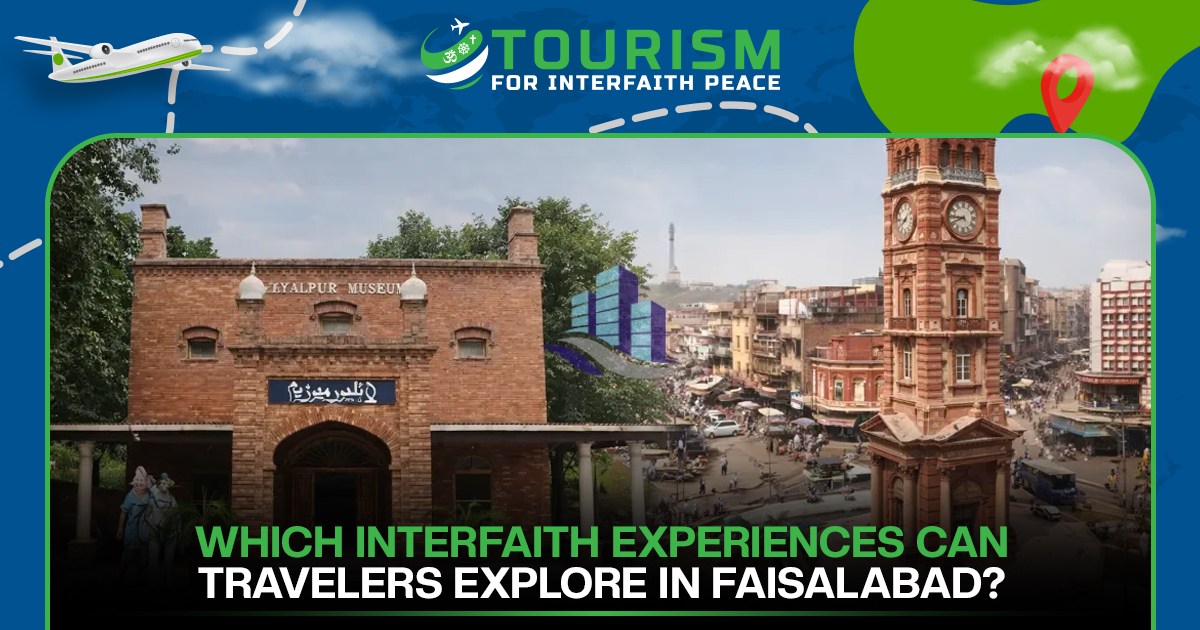
The Clock Tower Bazaar — the eight-armed commercial hub at the city’s centre — is the best place in Faisalabad to watch how different communities actually interact day to day. Vendors from different backgrounds, customers of every kind, and the ordinary noise of a commercial city going about its business. This is not a curated cultural experience. It is just Faisalabad.
The Christian Colony areas of the city, particularly around Gulberg and parts of the older town, give visitors a clear sense of how minority communities have built their own cultural institutions — schools, hospitals, community centres — within a majority-Muslim city. The Forman Christian institutions with historical roots in Faisalabad represent this investment in education across communities.
Some local civil society organisations and interfaith groups in the city host dialogue events, particularly around religious holidays. If your visit coincides with Easter, Christmas, Eid, or Diwali, it is worth asking locals whether any community events are open to outside guests. These informal occasions are often more illuminating than formal heritage tours.
Why Faisalabad Matters for Interfaith Tourism in Pakistan
Pakistan’s interfaith tourism conversation tends to centre on Lahore, Multan, Taxila, or the Kalash valleys. These are important, but they can create a misleading impression that religious diversity in Pakistan is either ancient history or confined to the north.
Faisalabad tells a different story. It is a modern, industrial, unromantic city where religious communities have maintained spaces, institutions, and practices not because the setting is scenic, but because the need is real. That is a more representative picture of cultural harmony in Pakistan than a carefully preserved heritage site.
For domestic tourists from smaller Pakistani cities, Faisalabad can also serve as an accessible introduction to interfaith awareness — a way to see that diversity is not an abstract value but a daily reality in Pakistan’s third-largest city.
Practical Travel Tips for Visiting Faisalabad’s Religious Sites
- Dress modestly when visiting any religious site, regardless of the faith tradition. Covered shoulders and legs are appropriate in mosques, churches, and temples alike.
- Ask before photographing inside active places of worship. Most communities are welcoming to respectful visitors, but it is worth checking first.
- Faisalabad is well connected by road and rail from Lahore (roughly 130 km), Islamabad (around 280 km), and Karachi. Daewoo and other express bus services run regularly from major cities.
- Local ride-hailing apps and rickshaws can cover most of the older city easily. The central bazaar area is walkable if you have the time.
- A two-day visit is enough to cover the main religious sites and get a feel for the different neighbourhoods. Stay near the city centre if you plan to explore on foot.
What Faisalabad Teaches Travelers About Coexistence
Faisalabad will not give you a postcard moment. There are no UNESCO-listed sites, no river ghats, no walled city to photograph from above. What it offers is more useful for a serious traveler: a clear-eyed look at how different communities share space in a contemporary Pakistani city.
The mosques, churches, and old temples here are not relics. They are part of how the city still works. And the people who maintain them — whether Muslim, Christian, or members of other communities — are not performing cultural harmony for visitors. They are just going about their lives.
For anyone genuinely curious about interfaith travel experiences in Pakistan, that ordinariness is exactly the point. The most durable form of coexistence is not preserved in museums. It shows up in everyday streets, shared markets, and neighbourhoods where people have been neighbours for generations.