| Key Takeaways A religious heritage site can be deeply sacred to one community while also holding wider value as part of humanity’s shared cultural record. Shared cultural heritage means respectful recognition, not appropriation — local and faith communities remain the primary stakeholders in how their heritage is interpreted. Preservation protects both physical structures and living heritage: ritual, craftsmanship, language, and community memory. Tourism can support preservation when conservation comes before visitor numbers, and creates risks when it doesn’t. Heritage encounters become meaningful through genuine human interaction, not sightseeing alone. |
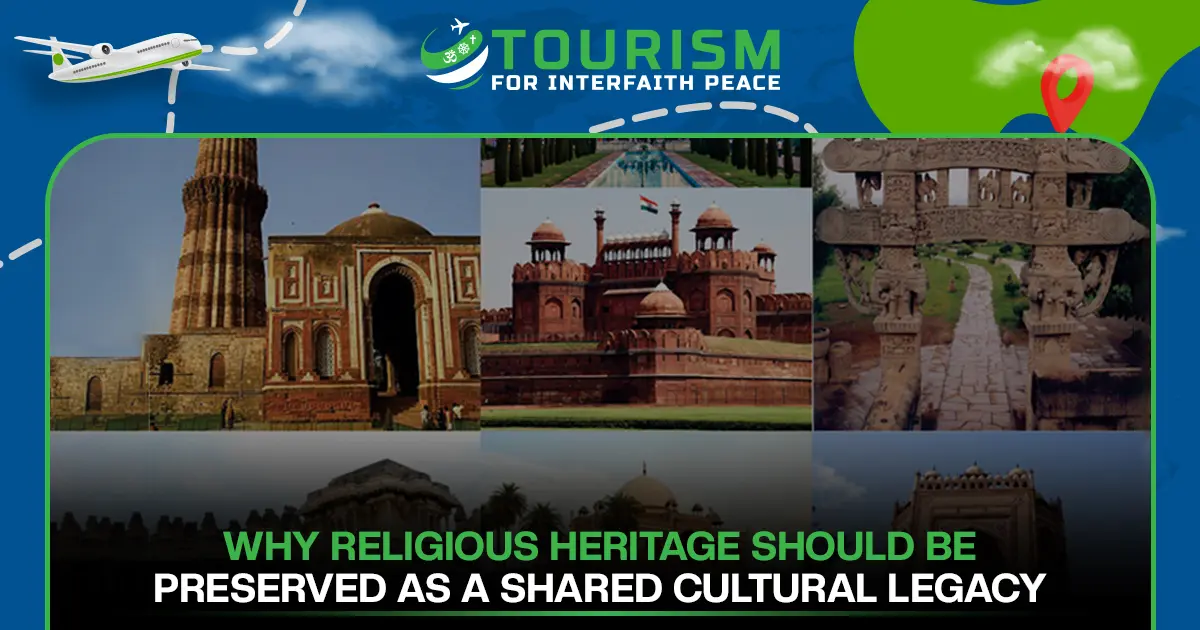
When a sacred building disappears, what is lost is rarely just stone, wood, or ornament. A collapsed shrine, a demolished temple, a church left to ruin — each takes with it a layer of memory that cannot be rebuilt from photographs. It takes stories of who worshipped there, who built it and why, who passed through its courtyards on pilgrimage or on trade routes, and what it meant to be part of the community that gathered around it. Religious heritage carries this weight because it sits at the intersection of the sacred and the historical: deeply meaningful to the community for whom it remains a living place of faith, and, at the same time, part of a broader human record that belongs to more than one memory.
Religious Heritage Is More Than a Building
A mosque, temple, gurdwara, church, or shrine is never only architecture. Each carries layers most visitors never see on the surface: the craftsmanship of the people who built it, the music or recitation practiced inside it, the rituals performed within its walls, the language used to describe it, and the generations of community history tied to its upkeep. A minaret or dome can be measured and photographed. The knowledge of how to maintain it, the meaning of its rituals, and the community’s relationship to the space cannot be captured the same way. Preservation, done well, has to consider both the physical structure and this living heritage — the practices and people that keep a site meaningful rather than merely intact.
Shared Heritage Does Not Mean Erasing Religious Identity
There is an important distinction between appreciating heritage as part of a shared human story and treating it as a general cultural artifact detached from the community it belongs to. A site can be understood as historically and artistically significant to a wider audience while remaining, first and always, sacred to the people who worship there. Recognizing wider cultural value should never come at the cost of religious identity.
This is why responsible heritage work begins with respect for the community itself. Faith communities and local custodians should have a meaningful role in how their heritage is interpreted, presented, and opened to outside visitors — not as a formality, but because they hold knowledge and authority over their own sacred spaces that no outside institution can substitute.
Preserving Religious Heritage Preserves Stories of Human Connection
Religious sites often sit at the crossroads of much larger histories — migration routes, trade networks, artistic influences carried between regions, neighborhoods where different communities lived side by side. A single site can hold evidence of coexistence and cultural exchange alongside evidence of conflict and displacement; honest preservation makes room for the full history rather than a simplified version of it. That fuller record is exactly what allows later generations to study how communities actually related to one another, instead of relying on assumption or nostalgia.
Religious Heritage Can Support Interfaith Understanding
Encountering a heritage tradition that isn’t your own can open real curiosity — about the history behind a ritual, the reasoning behind an architectural choice, the community still connected to a space today. But a visit alone does not automatically produce understanding. Standing in a courtyard and reading a placard is not the same as understanding why that courtyard still matters to the people who gather there. The quality of interpretation and interaction is what determines whether a visit becomes genuine learning or stays at the level of sightseeing.
That distinction is central to why people-to-people connections matter in interfaith tourism: heritage becomes far more meaningful when visitors can encounter the people, communities, and living traditions still connected to a site, rather than experiencing it as an isolated monument.
Tourism Can Help Preserve Heritage — If It Is Done Responsibly
Well-managed tourism can support conservation funding, local employment, documentation, restoration, and public awareness of a site’s history. It can also create real risk: overcrowding, commercialization, disrespectful behavior, physical damage to fragile structures, superficial interpretation that flattens complex history into a photo opportunity, and pressure on communities that live around a site. None of these risks make tourism inherently harmful to heritage — but they make clear that preservation has to come before visitor numbers, not the other way around.
What Responsible Visitors Can Do
Respectful engagement with sacred heritage is mostly a matter of preparation and restraint:
- Learn about a site’s history and significance before visiting.
- Follow dress expectations and any restrictions on photography.
- Observe worship quietly, without treating it as a performance.
- Listen to local guides and custodians rather than assuming context.
- Ask questions respectfully, and accept that some may go unanswered.
- Understand the difference between visiting as a tourist and joining as a pilgrim.
- Leave the space exactly as you found it.
Why Preserving Religious Heritage Matters for Future Generations
What survives today becomes the material future generations will use to understand history, encounter unfamiliar traditions, study architecture and art, and build a more informed sense of how communities have coexisted and changed over time. A preserved site does not just outlast the present generation; it gives the next one something to study that no textbook description can fully replace — a physical, specific, human place.
From Heritage Preservation to a Culture of Peace
Preservation alone does not create peace, and it would be misleading to suggest otherwise. What preserved heritage can do is create a platform — a shared point of reference where learning can lead to encounter, encounter can lead to dialogue, and dialogue can lead to understanding and respect. Whether that potential is realized depends on how thoughtfully heritage is presented and how genuinely visitors and communities are willing to meet one another.
Conclusion
Religious heritage should not be preserved simply because old buildings hold value on their own. It should be preserved because these places carry human memory, community identity, artistic knowledge, and evidence of how people have connected across generations and, at times, across faiths. Protecting that record is a responsibility shared by communities safeguarding their own heritage, institutions supporting conservation, tourism professionals prioritizing responsibility over numbers, and visitors willing to approach sacred places with humility. What is preserved today becomes what future generations inherit — not just as history, but as an invitation to understand one another a little better.