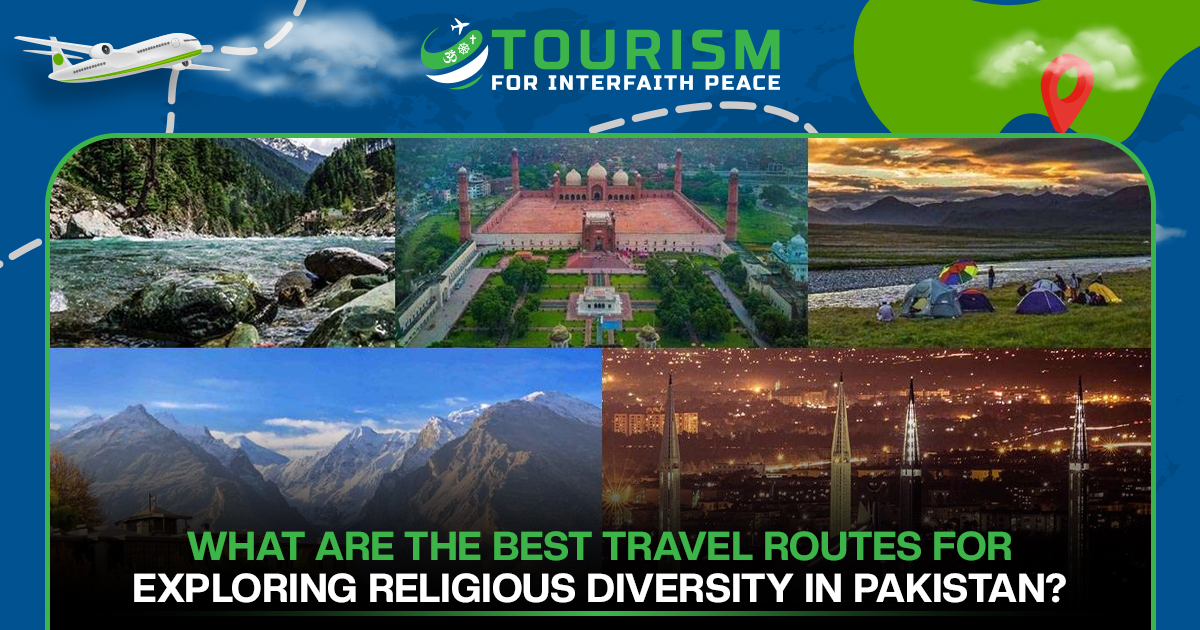
The best routes for religious diversity in Pakistan are Islamabad–Taxila–Peshawar for Buddhist and Gandharan heritage, Lahore–Nankana Sahib–Kartarpur for Sikh pilgrimage, Multan–Bahawalpur for Sufi shrines, Karachi–Thatta for Islamic and colonial-era churches, and the Katas Raj temples near Islamabad–Lahore for Hindu heritage. Each route pairs sacred sites with cultural immersion.
Most travelers picture Pakistan through a single lens — mountains, mosques, maybe the Karakoram Highway. Few realize it holds one of the richest interwoven religious landscapes in South Asia: Buddhist stupas that once drew scholars from China and Greece, the birthplace of Sikhism, temples tied to the Mahabharata, Sufi shrines that have hosted devotees of every faith for centuries, and churches shaped by a colonial and missionary past. Pakistan’s emerging interfaith destinations are gaining attention precisely because so few outsiders have mapped them into a coherent journey. Here’s how to do that.
Islamabad → Taxila → Peshawar: The Buddhist and Gandharan Trail
This route traces the Gandhara civilization, which flourished from roughly the 5th century BCE to the 2nd century CE. Taxila, a UNESCO World Heritage Site since 1980 and located about 30 kilometers from Islamabad, was once among the world’s earliest centers of Buddhist learning. Its Dharmarajika stupa, Jaulian monastery, and Sirkap ruins — where Buddhist, Hindu, and Greek temple foundations sit side by side — reveal a city built at a genuine crossroads of civilizations. The Taxila Museum houses one of Pakistan’s most significant collections of Gandharan sculpture. From there, continuing toward Peshawar and the Swat Valley extends the journey along what specialists now call the Buddhist Trail, a route linking over 150 documented Buddhist sites.
Ideal duration: 3–4 days.
Best season: October to March, when temperatures are mild.
Why it matters: this route lets travelers see how Persian, Greek, Central Asian, and South Asian traditions physically overlapped on the same ground — a tangible lesson in coexistence rather than an abstract one.
Lahore → Nankana Sahib → Kartarpur: The Sikh Heritage Route
Nankana Sahib, birthplace of Guru Nanak, and the Kartarpur Corridor together form the emotional center of Sikh pilgrimage in Pakistan. Kartarpur itself is where Guru Nanak spent his final years and founded the first Sikh commune; the current Gurdwara Darbar Sahib was rebuilt in the 19th century after floods destroyed the original structure. The corridor opened in 2019 as a visa-free crossing for Indian pilgrims, drawing praise from the UN as a symbol of interfaith cooperation — though travelers should note that cross-border access has fluctuated with diplomatic tensions in recent years, so checking current corridor status before planning a visit is essential. Pakistani citizens and international visitors can generally visit these sites without the corridor’s cross-border restrictions. These Sikh heritage experiences also include Panja Sahib in Hasan Abdal, associated with a handprint attributed to Guru Nanak in local tradition.
Ideal duration: 2 days from Lahore.
Best season: November, around Guru Nanak’s birth anniversary, for a fuller cultural experience — though this draws large crowds.
Responsible travel tip: dress modestly, remove footwear before entering the Gurdwara, and cover your head as a sign of respect.
Multan → Bahawalpur: The Sufi and Desert Heritage Route
Multan is often called the City of Saints for its concentration of Sufi shrines, including the tomb of Hazrat Shah Rukn-e-Alam. Sufi tradition in this region has historically drawn devotees across religious lines, treating shrines as spaces of shared devotion rather than sectarian boundary. Continuing south to Bahawalpur adds the Noor Mahal palace and the Cholistan Desert’s Derawar Fort to the itinerary, broadening the trip from purely religious sites into the wider cultural fabric that shaped them. Readers wanting a deeper grounding in this theme can explore Sufi shrines across Pakistan and their role in interfaith gathering.
Ideal duration: 3 days.
Best season: November to February, avoiding the region’s intense summer heat.
Karachi → Thatta: Islamic Architecture and Colonial-Era Churches
Karachi’s Christian heritage, visible in churches built during the British colonial period, sits alongside a cosmopolitan port-city history shaped by Parsi, Hindu, and Muslim communities. Traveling on to Thatta adds the Makli necropolis — one of the largest funerary sites in the world — and the Shah Jahan Mosque, an example of Mughal-era tilework. This route works well for travelers interested in how architecture itself becomes a record of who lived where, and when.
Ideal duration: 2 days.
Best season: November to February.
Katas Raj: A Detour for Hindu Heritage
Just off the Islamabad–Lahore motorway near Chakwal sits the Katas Raj temple complex, dedicated to Shiva and linked in tradition to the Mahabharata‘s Pandava brothers. The site also holds a gurdwara associated with Guru Nanak’s travels, making it a rare single location where Hindu and Sikh heritage physically overlap. Restoration efforts since 2006, including work on the complex’s sacred pond, have helped preserve a site that had fallen into neglect after Partition.
Traveling Responsibly
Respecting religious diversity while traveling means more than reading a dress code in advance. Ask before photographing worshippers or ritual spaces. Hire local guides where available — they add context no plaque can. Support small businesses near heritage sites rather than routing everything through large tour operators. And treat every shrine, temple, or gurdwara as a living space of devotion, not a backdrop.
Why This Kind of Travel Matters
This is not understanding interfaith tourism as pilgrimage alone — it’s travel structured around encounter. Visiting a Sikh gurdwara, a Hindu temple, and a Sufi shrine within the same trip does something a documentary can’t: it puts a traveler physically inside spaces shaped by communities they may never have met. That proximity tends to erode assumptions faster than any lecture on tolerance.
Conclusion
Pakistan’s religious geography is denser and more layered than most travel guides suggest. From Gandhara’s Buddhist ruins to Sikhism’s birthplace, from Sufi shrines that have never asked a visitor’s faith to Hindu temples still active after centuries of upheaval, these routes offer something increasingly rare: a chance to see coexistence as it was actually built, brick by brick, over two thousand years.
FAQ
Which religious sites should travelers visit in Pakistan?
Key sites include Taxila’s Buddhist ruins, Nankana Sahib and Kartarpur for Sikh heritage, Multan’s Sufi shrines, Katas Raj Hindu temples near Chakwal, and colonial-era churches in Karachi. Each reflects a distinct chapter of the region’s religious history.
Is Pakistan safe for interfaith tourism?
Major heritage routes near Islamabad, Lahore, and Karachi are generally well-traveled and accessible with standard travel precautions. Always check current government travel advisories and local conditions before visiting any site, especially near sensitive border areas.
What is the best itinerary for religious tourism in Pakistan?
A 7–10 day trip combining Islamabad–Taxila–Peshawar, Lahore–Nankana Sahib, and a Katas Raj detour covers Buddhist, Sikh, and Hindu heritage efficiently. Adding Multan extends the trip into Sufi and Islamic architectural history.
Which city has the greatest religious diversity?
Lahore and Islamabad offer the most accessible concentration of multi-faith heritage sites within short travel distances, though Karachi’s colonial and port-city history adds distinct Christian and Parsi layers to its own religious landscape.
How can tourists travel respectfully at religious sites?
Dress modestly, ask permission before photographing worshippers, remove footwear where required, avoid visiting during active prayer unless invited, and consider hiring local guides who can explain customs and historical context accurately.