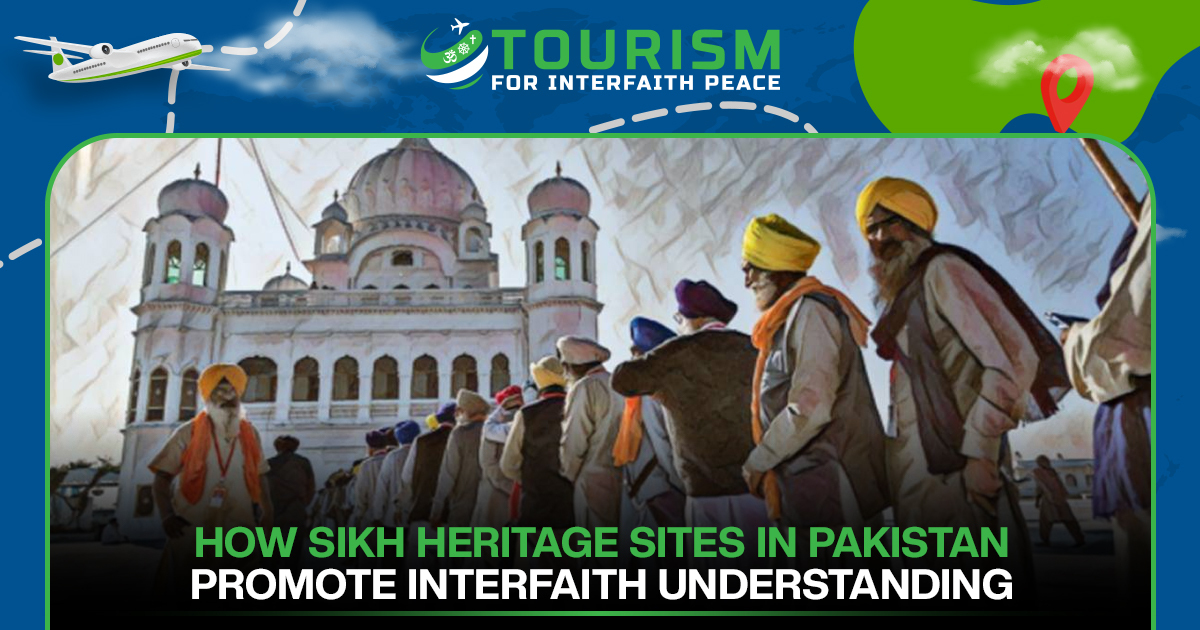
Every October, something remarkable happens at the Kartarpur Corridor. Sikh pilgrims from India, Canada, the United Kingdom, and the United States cross into Pakistan to visit the final resting place of Guru Nanak Dev Ji, the founder of Sikhism. They walk across fields that were, within living memory, divided by one of the most fraught borders on earth. And many of them, when asked afterward about the experience, struggle to describe it in purely religious terms. It is not simply that they visited a sacred site. It is that they were received — with warmth, with hospitality, with a kind of welcome that complicated everything they thought they knew about the country on the other side of the fence.
This is what Sikh heritage tourism in Pakistan does that conventional tourism cannot. It does not just move people through landscapes. It moves them through assumptions. Pakistan holds within its borders some of the most significant sites in Sikh religious history — Gurdwara Darbar Sahib in Kartarpur, Gurdwara Panja Sahib in Hassan Abdal, Gurdwara Janam Asthan in Nankana Sahib, the birthplace of Guru Nanak himself. These are not peripheral historical footnotes. They are places that define the spiritual geography of a religion with 25 to 30 million adherents worldwide, most of whom had no access to them for decades.
As Pakistan opens these spaces, carefully and with growing intention, the conversation around religious tourism, interfaith understanding, and cultural diplomacy is changing. Pakistan is emerging not as a reluctant custodian of someone else’s heritage, but as an active participant in a story about what shared history can do when it is allowed to function.
The Historical Importance of Sikh Heritage in Pakistan
The partition of British India in 1947 drew one of history’s most consequential borders directly through the heartland of Sikh religious and cultural life. The Punjab, which means “five rivers,” had been the spiritual home of the Sikh faith since the fifteenth century. Guru Nanak was born there, in what is now the Pakistani city of Nankana Sahib. The faith’s most sacred sites, its founding narratives, and many of its most important gurdwaras — Sikh houses of worship — fell on the Pakistani side of a border that millions of people crossed in both directions amid one of the largest forced migrations in human history.
For most of the decades that followed, those sites were largely inaccessible to Sikh pilgrims. The geopolitical tension between India and Pakistan made travel difficult, irregular, and often impossible. Gurdwaras fell into disrepair. Some were used for other purposes. The connection between a living faith and its foundational geography was severed in ways that caused genuine grief within the Sikh community globally.
What has changed in the past twenty years, and accelerated significantly since the opening of the Kartarpur Corridor in 2019, is that Pakistan has begun to treat Sikh heritage not as a historical inconvenience but as a cultural responsibility and a diplomatic asset. Investment in site restoration, improved pilgrimage infrastructure, and the establishment of formal corridors for religious visitors has reframed the conversation. These sites are not curiosities. They are living sacred spaces, and their preservation matters to the spiritual identity of millions of people who share a history with the land they stand on.
| “Shared history does not disappear when borders are drawn. It waits, in stone and soil, for the moment when people are ready to return to it.” |
Sikh Heritage Sites as Bridges of Interfaith Understanding
Can travel reshape religious perceptions? The evidence from Kartarpur and from the wider Sikh pilgrimage circuit in Pakistan suggests that it can, and that it does so through a mechanism that is difficult to replicate through any other means. When a person stands in Gurdwara Panja Sahib in Hassan Abdal, where the handprint of Guru Nanak is said to be preserved in rock, they are not simply a tourist looking at a historical monument. They are a participant in a living tradition, received by a country that, by all the narratives they may have grown up with, might have been expected to be indifferent or hostile to that tradition.
The experience of being welcomed — of finding langar, the free community meal that is central to Sikh practice, served with care in a gurdwara on Pakistani soil — does something to a person’s assumptions that arguments, articles, and diplomatic statements cannot. It provides an embodied counter-narrative. Not “Pakistan is peaceful” as an abstract claim, but “I was received with hospitality in Pakistan” as a lived fact. The difference in persuasive force is enormous.
What do shared sacred spaces teach us about unity? They teach us, perhaps most importantly, that the religious landscape of the subcontinent was always more complex than partition narratives suggest. Sikh, Hindu, Muslim, and Christian communities have lived alongside each other on this land for centuries, in patterns of exchange, friction, and coexistence that do not reduce neatly to the categories that modern nation-states impose. The gurdwaras in Pakistan are not anomalies. They are evidence of a history that is deeper and more entangled than the politics of any particular era.
Key Sikh Heritage Sites in Pakistan That Promote Peace Tourism
Nankana Sahib, about 75 kilometres from Lahore, is where the story begins. Guru Nanak Dev Ji was born here in 1469, and the gurdwaras that mark the significant moments of his early life — Gurdwara Janam Asthan, Gurdwara Bal Lila, Gurdwara Kiara Sahib — draw tens of thousands of Sikh pilgrims each year, particularly during Gurpurab, the celebration of Guru Nanak’s birthday. The town has been described by Sikh visitors as an emotional experience unlike any other on the pilgrimage circuit. To stand at the place of a founder’s birth is a particular kind of encounter with history.
Kartarpur, in the Narowal district near the Indian border, is where Guru Nanak spent the last eighteen years of his life, farming and teaching. Gurdwara Darbar Sahib here is considered among the most sacred sites in Sikhism. The Kartarpur Corridor, opened in November 2019 after years of diplomatic negotiation, allows Indian Sikh pilgrims to visit visa-free. It was described at the time as a peace gesture of significant symbolic weight, and the response from pilgrims confirmed that weight. Families who had never expected to see this site in their lifetimes crossed the corridor in tears.
Hassan Abdal, northeast of Rawalpindi, holds Gurdwara Panja Sahib, built around a sacred rock that bears what devotees believe is the handprint of Guru Nanak. The site attracts pilgrims from across the Sikh diaspora and is notable for the quality of its preservation and the warmth with which Pakistani authorities and local communities receive visitors. It is, by many accounts, one of the most moving interfaith tourism experiences in the region.
These three sites together form a pilgrimage geography that is unique in the world: sacred to one of the major world religions, located within a country of a different religious majority, accessible to international visitors, and actively maintained and presented as symbols of shared heritage rather than contested territory.
| “In Nankana Sahib, the pilgrim is not a foreigner visiting a foreign site. They are a descendant returning to an origin.” |
The Role of Interfaith Tourism in Building Global Harmony
Tourism is often discussed in terms of its economic dimensions: receipts, arrivals, infrastructure investment. These matter, but they do not capture what makes interfaith tourism distinct. Interfaith tourism operates at the level of meaning, not just movement. When a Sikh family from Vancouver visits Nankana Sahib, or when a European scholar visits Hassan Abdal as part of a study of Mughal-era religious architecture, or when a Pakistani Muslim student volunteers as a guide at a gurdwara during Gurpurab — what is happening is not simply tourism. It is a form of soft diplomacy that operates without the awkwardness and formality of official diplomatic channels.
The stereotypes that sustain division between communities and nations are almost always abstract. They are maintained by distance. The Pakistani who has never met a Sikh pilgrim and the Sikh diaspora member who has never visited Pakistan carry their mutual assumptions in a kind of sealed container, unopened because there has been no occasion to open it. Religious heritage tourism creates those occasions. It does not guarantee transformation, but it creates the conditions under which transformation becomes possible.
Cultural sensitivity is a precondition for this kind of tourism to work. Sites like the gurdwaras in Pakistan are not theme parks or historical curiosities — they are active places of worship for a living community. The way they are managed, the training provided to guides and security personnel, the protocols around dress and behaviour for non-Sikh visitors, all of these details signal whether the host country is taking the spiritual dimension of the visit seriously. Pakistan has invested meaningfully in getting these details right, and that investment has been noticed by the pilgrims who experience it.
| “The stereotypes that divide communities are almost always maintained by distance. Travel closes that distance, sometimes faster than decades of diplomacy.” |
Pakistan’s Growing Identity as an Interfaith Tourism Destination
The global interest in Pakistan as a travel destination has grown considerably over the past decade, driven initially by adventure tourism in the northern mountains and increasingly by cultural and heritage tourism that extends across the country. Sikh pilgrimage tourism is now a significant and growing component of that story, but it sits within a broader pattern of Pakistan opening itself to international visitors with a different self-presentation than had been common in earlier decades.
Government and private sector initiatives have both contributed to this shift. The Evacuee Trust Property Board, which manages Sikh and Hindu religious properties in Pakistan, has overseen restoration work at key gurdwaras. The Kartarpur Corridor project involved substantial infrastructure investment and the navigation of complex India-Pakistan diplomatic dynamics. Visa-on-arrival facilities for Sikh pilgrims, improved gurdwara facilities, and the establishment of formal pilgrimage packages have all made the experience of visiting these sites more accessible and more consistently positive.
The narrative emerging from this investment is one that tourism practitioners and interfaith scholars are beginning to articulate clearly. There is more to explore in this direction at Why Pakistan Is Emerging as a Unique Interfaith Travel Destination, which examines how the country’s religious diversity is increasingly understood as a cultural asset rather than a complication.
What Pakistan offers interfaith tourists is not just access to sacred sites, but access to a layered civilisational history in which multiple faiths left their marks. The Indus Valley, the Buddhist monasteries of Gandhara, the Mughal mosques and tombs, the Sikh gurdwaras, the Hindu temples, and the colonial-era Christian churches — the country contains, within its borders, one of the most extraordinary concentrations of religious heritage anywhere on earth. The Sikh pilgrimage circuit is not a niche within that story. It is one of its most emotionally significant chapters.
Responsible Travel and Respectful Cultural Engagement
Interfaith heritage sites require a particular kind of visitor mindfulness that standard tourism guidance does not always address. The gurdwaras in Pakistan are not museums. Guru Granth Sahib Ji, the Sikh holy scripture, is present in active gurdwaras and is treated with the same reverence accorded to a living teacher. Visitors who enter a gurdwara are expected to cover their heads, remove footwear, and refrain from bringing tobacco or alcohol within the premises. These are not arbitrary rules — they reflect the spiritual logic of the space, and understanding that logic is what distinguishes respectful from merely compliant behaviour.
Community engagement is the other dimension of responsible interfaith travel that deserves emphasis. The local communities around Pakistan’s gurdwaras — mostly Muslim communities who have, in many cases, maintained and protected these sites through decades when no Sikh visitors were coming — have their own relationship with the heritage on their doorstep. Some gurdwaras have benefited from the active care of local residents who recognise them as part of the shared cultural landscape of their town. Acknowledging and engaging with that care, rather than treating the sites as belonging exclusively to the pilgrimage tradition, is part of what makes interfaith tourism different from conventional religious tourism.
Visitors who want to prepare meaningfully for this kind of engagement will find useful orientation in How Interfaith Travel Builds Tolerance and Reduces Cultural Misunderstanding, which examines the psychological and social dynamics of cross-cultural religious travel in depth.
Further Reading: Interfaith Travel in Context
The Sikh pilgrimage circuit in Pakistan does not exist in isolation. It is part of a broader ecosystem of interfaith heritage tourism that includes sites and experiences across the country, in cities that first-time visitors often underestimate as cultural destinations.
Those interested in extending their understanding of Pakistan’s interfaith landscape beyond the Sikh pilgrimage route will find What Are Islamabad’s Hidden Religious and Cultural Gems for Interfaith Travelers? a useful starting point. The capital city contains a more complex religious and cultural landscape than its modern architecture suggests.
For the broader conceptual framework within which Sikh heritage tourism sits, How Cultural Experiences Foster Peace and Understanding in Tourism offers a thoughtful analysis of how cultural immersion functions as a mechanism for reducing prejudice and building cross-community empathy.
How Tourism for Interfaith Peace Supports This Vision
Tourism for Interfaith Peace was established around the conviction that travel, when it is designed with intention and cultural respect, can do things that conventional diplomacy and public education cannot. The organisation works at the intersection of heritage tourism, interfaith dialogue, and responsible travel practice, developing programmes and partnerships that allow visitors to engage with Pakistan’s religious and cultural landscape in ways that are both meaningful and sustainable.
The approach is not to market Pakistan in general terms, but to create specific, curated experiences around sites and communities where interfaith encounter is most powerful. The Sikh pilgrimage circuit — Nankana Sahib, Kartarpur, Hassan Abdal — is central to that work, both because of the sacred significance of these sites and because of the particular weight of the encounter they create: pilgrims from a diaspora community, many of whom had never expected to visit these places, welcomed in a country they may have been told to regard with suspicion.
If you are considering a visit to Pakistan’s Sikh heritage sites, or if you are an organisation interested in developing interfaith tourism programming in the region, the team at Tourism for Interfaith Peace is available to help. Get in Touch With Our Team to discuss how we can support your journey.
Why Sikh Heritage Tourism Matters Today
Global polarisation has made the question of how communities with different religious identities relate to each other more urgent than it has been in decades. The political dynamics that exploit religious difference are well-funded, well-organised, and effective at their purpose. The forces that work against those dynamics — exchange, encounter, the discovery of shared history — tend to be quieter and less visible, even when their effects are profound.
Sikh heritage tourism in Pakistan is one of those quiet forces. It does not make the news in the way that political confrontations do. But the Sikh pilgrim who returns from Kartarpur having been received with unexpected warmth, the Pakistani student who guided a visiting family through Gurdwara Panja Sahib and found themselves thinking differently about what their country contains, the Canadian Sikh whose grandparents were displaced by partition and who stood for the first time in the village where her family’s story began — these experiences accumulate. They become part of how people understand what is possible between communities that have been told, over and over, that understanding is not available to them.
Cultural diplomacy is a phrase that tends to sound abstract until you see it working. At Kartarpur, at Nankana Sahib, at Hassan Abdal, it is working. Not quickly, not without complications, not in ways that resolve the larger geopolitical tensions. But genuinely, and in ways that matter to the people experiencing it.
A Final Reflection
There is a quality to Sikh heritage tourism in Pakistan that resists easy summarising. It is not simply that believers visit sacred sites — that happens everywhere. It is that these particular sites, in this particular country, carry the weight of separation and the possibility of return simultaneously. To visit Nankana Sahib as a Sikh pilgrim is to walk through a place that your faith’s history has always included but that political history tried to put beyond reach. The experience of finding it intact, preserved, and welcoming, does something to a person that transcends the categories of tourism or diplomacy.
Pakistan’s Sikh heritage sites are teaching a lesson that the wider world would benefit from learning more widely: that the places where different communities’ histories intersect are not problems to be managed. They are resources. They carry the evidence that coexistence is not a novel aspiration but an ancient and recurring human practice, one that the present moment is capable of recovering.
What if travel was not just movement — but memory? What if the act of returning to shared sacred ground was itself a form of peace-making? The gurdwaras of Pakistan suggest, quietly and powerfully, that it is.
Frequently Asked Questions
What are the most important Sikh heritage sites in Pakistan?
The three principal Sikh heritage sites in Pakistan are Gurdwara Janam Asthan in Nankana Sahib, the birthplace of Guru Nanak Dev Ji; Gurdwara Darbar Sahib in Kartarpur, where Guru Nanak spent the last years of his life; and Gurdwara Panja Sahib in Hassan Abdal, which holds a rock bearing what devotees believe is the handprint of Guru Nanak. Together they form the core of the Sikh pilgrimage circuit in Pakistan and attract tens of thousands of visitors annually.
Can Sikh pilgrims from India visit Pakistan’s gurdwaras?
Yes. The Kartarpur Corridor, opened in November 2019, allows Indian Sikh pilgrims to cross into Pakistan visa-free specifically to visit Gurdwara Darbar Sahib in Kartarpur. For other sites, Indian pilgrims can visit under existing pilgrimage agreements between the two governments, which provide for periodic access to Nankana Sahib, Hassan Abdal, and other significant gurdwaras. Pilgrims from other countries typically access these sites through standard tourist or visa-on-arrival arrangements.
How does Sikh heritage tourism promote interfaith understanding?
Sikh heritage tourism creates direct encounters between Sikh pilgrims and Pakistani Muslim communities that complicate and enrich the assumptions both communities may carry about each other. The experience of being received with hospitality and care in a place one had been told to regard with suspicion is qualitatively different from any amount of information about that place. These encounters accumulate, shaping how communities and their diaspora members understand what is possible across religious and national divides.
Is Pakistan safe for Sikh pilgrims and interfaith tourists?
Pakistani authorities treat Sikh pilgrimage sites as diplomatically significant destinations, and the security and hospitality infrastructure around major gurdwaras reflects that status. Pilgrim groups visiting sites like Nankana Sahib, Hassan Abdal, and Kartarpur report consistently positive experiences with Pakistani authorities and local communities. As with any international travel, visitors are encouraged to stay informed through official channels and travel with a reputable organisation familiar with the region.
What etiquette should visitors observe at Sikh gurdwaras in Pakistan?
Visitors to gurdwaras should cover their heads before entering — most sites provide head coverings for those who do not bring their own. Footwear must be removed at the entrance. Tobacco, alcohol, and non-vegetarian food are not permitted within gurdwara premises. Visitors are welcome to partake in langar, the free community meal served to all regardless of faith or background, as a gesture of equality and shared humanity. Photography policies vary by site; when in doubt, ask before photographing sacred spaces or worshippers.