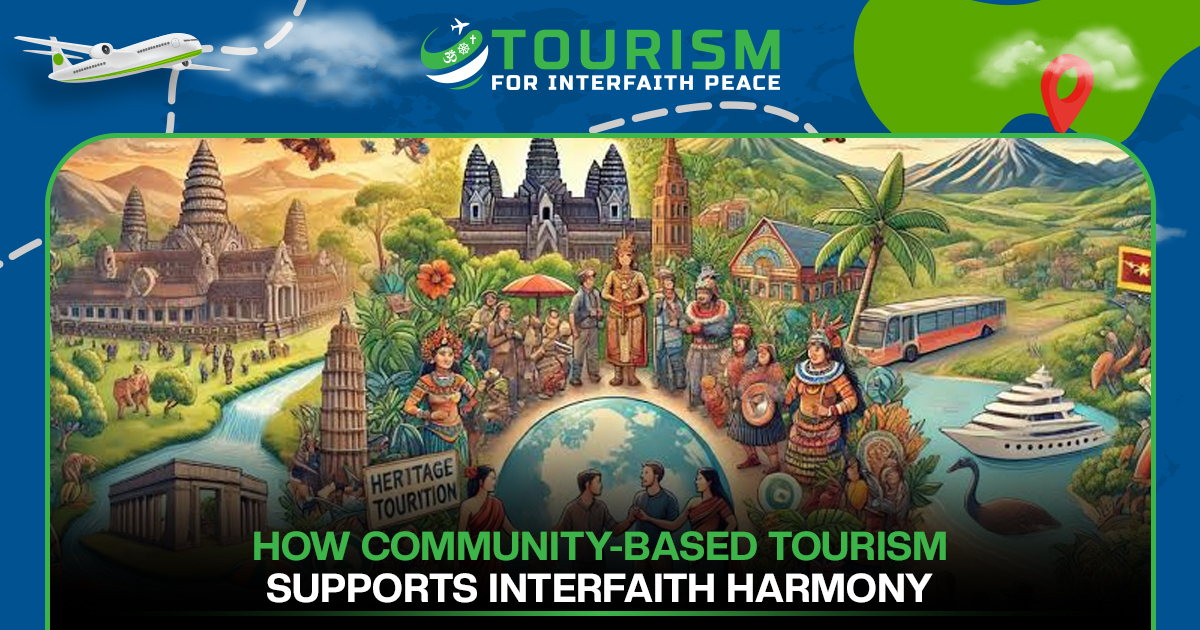
Community-based tourism (CBT) is a model of travel in which local communities actively plan, host, and benefit from tourism activity, rather than serving as a backdrop to it. By putting residents — including artisans, guides, and religious site caretakers — at the center of the visitor experience, CBT creates direct, respectful contact between travelers and host communities, which is one of the most effective ways tourism can support interfaith understanding.
Tourism has always had the potential to be either extractive or exchange-based. The extractive version moves visitors past a place, collecting photographs and souvenirs with minimal contact with the people who actually live there. The exchange-based version does something different: it puts local communities in the driver’s seat, turning a visit into a genuine encounter rather than a transaction.
This second model — community-based tourism — has quietly become one of the more effective tools for building interfaith understanding, precisely because it doesn’t rely on lectures or formal dialogue. It relies on shared meals, guided walks led by residents, and religious sites explained by the people who tend them. That kind of contact tends to do more for mutual respect than any brochure.
What Is Community-Based Tourism?
Community-based tourism (CBT) is a form of sustainable tourism in which the local community holds a central, active role in planning, hosting, and benefiting from tourism activity, rather than a passive one.
- Definition — CBT is tourism owned, operated, or substantially shaped by the community it takes place in, rather than externally imposed on it.
- Core principles — local participation, fair economic benefit, cultural respect, and environmental sustainability.
- Local participation — residents act as guides, hosts, and decision-makers, not just service staff.
- Sustainable development — tourism revenue is reinvested in the community rather than flowing mostly to outside operators.
- Cultural preservation — traditions, crafts, and heritage sites are maintained because the community has a direct stake in their continuity.
- Responsible tourism — visits are structured around minimizing harm and maximizing genuine value for the host community.
How Community-Based Tourism Encourages Interfaith Harmony
When a religious site is explained by its own caretaker, or a festival is experienced alongside the families who celebrate it, tourism becomes a form of cultural exchange rather than observation from a distance.
- Cultural exchange — visitors and hosts share direct conversation, not just a transaction at a ticket counter.
- Mutual respect — asking questions and receiving thoughtful answers builds respect in both directions.
- Breaking stereotypes — a single respectful, informed conversation can undo assumptions built by years of secondhand narratives.
- Shared experiences — meals, festivals, and guided visits create memories that are harder to reduce to stereotype afterward.
- Dialogue between communities — CBT often creates informal, ongoing relationships between host families and returning travelers or tour operators.
- Peacebuilding through tourism — sustained, respectful contact between different faith communities is a well-documented soft mechanism for reducing intergroup tension over time.
How to Travel Responsibly as a Solo Interfaith Traveler offers a practical look at how individual travelers can approach these encounters with the right preparation and etiquette.
Traditional Tourism vs Community-Based Tourism
| Traditional Tourism | Community-Based Tourism |
| Revenue often flows mainly to outside operators | Revenue is retained and reinvested locally |
| Sites are viewed from a distance | Sites are explained by residents and caretakers |
| Limited or no direct contact with host communities | Direct, sustained contact between travelers and hosts |
| Heritage preservation is incidental | Heritage preservation is often community-driven |
| Standardized, replicable experiences | Locally distinct, harder-to-replicate experiences |
Benefits for Local Communities
- Employment opportunities — guiding, hospitality, and site management roles that keep income within the community.
- Small businesses — homestays, local eateries, and transport services that grow around visitor demand.
- Local artisans — craftspeople gain a direct market for traditional work, supporting skills that might otherwise fade.
- Heritage conservation — communities with an economic stake in a site tend to protect it more actively.
- Youth engagement — young people find roles as guides and interpreters, which builds pride in local heritage rather than a desire to leave it behind.
- Women’s participation — CBT frequently opens income opportunities in hospitality and crafts that formal tourism structures often overlook.
- Economic sustainability — diversified, locally rooted income tends to be more resilient than single-employer local economies.
Why Travelers Benefit from Community-Based Experiences
- Authentic cultural experiences — insight that comes from residents rather than scripted tour commentary.
- Responsible travel — visitor spending directly supports the community being visited.
- Learning local traditions — context and nuance that a guidebook alone cannot fully convey.
- Visiting religious and heritage sites respectfully — local hosts can explain etiquette that travelers might otherwise miss.
- Building meaningful human connections — the kind of memory that outlasts a typical sightseeing itinerary.
| Community Impact When tourism revenue stays local, it tends to fund exactly the things that sustain interfaith tourism long-term — site maintenance, guide training, and the preservation of festivals and crafts that make a destination worth visiting in the first place. |
Best Practices for Responsible Community-Based Interfaith Tourism
- Respect local customs, including dress codes and behavior expectations at religious sites.
- Support local businesses — homestays, local guides, and community-run eateries over outside chains.
- Hire local guides, who bring context and etiquette knowledge that improves the visit for everyone.
- Protect heritage sites by following posted guidelines and avoiding unnecessary handling or crowding.
- Ask before photographing people or religious ceremonies — consent matters more than the photo.
- Travel sustainably, minimizing waste and environmental impact at sensitive sites.
- Practice cultural sensitivity by observing before acting and asking respectful questions rather than assuming.
What Documents and Permissions Are Needed to Visit Religious Sites? covers the practical requirements that vary by site, so travelers can prepare properly in advance.
Travelers weighing how much structure they want in their trip may also find it useful to review How to Choose the Right Tour Operator for Interfaith Travel before booking.
Conclusion
Community-based tourism offers something increasingly rare in modern travel: genuine, mutually beneficial contact between visitors and the communities they visit. For interfaith understanding specifically, that contact matters more than any formal dialogue program, because it happens organically — over a shared meal, a guided walk, a conversation at a religious site with the person who actually cares for it.
Traveling this way asks a little more of visitors — more preparation, more humility, more willingness to be a guest rather than a spectator. In return, it offers a kind of understanding that outlasts the trip itself, and it leaves local communities stronger, not just visited. That exchange, repeated one respectful traveler at a time, is how tourism becomes a genuine bridge between faiths rather than a barrier between them.
Frequently Asked Questions
What is community-based tourism?
Community-based tourism is a model in which local communities actively plan, host, and financially benefit from tourism, rather than serving only as a backdrop for outside operators.
How does community-based tourism support interfaith harmony?
It creates direct, respectful contact between travelers and host communities through shared meals, guided visits, and conversations, which builds mutual understanding more effectively than passive sightseeing.
Is community-based tourism more expensive than traditional tourism?
Not necessarily. Costs vary by destination and structure, but CBT often offers comparable pricing while ensuring more of the spending stays within the local community.
How can travelers find legitimate community-based tourism experiences?
Look for operators that clearly involve local guides, homestays, or community-owned enterprises, and that are transparent about how revenue is shared with the host community.
Why is local participation important in tourism planning?
Local participation ensures tourism reflects the community’s own priorities and traditions, rather than an outsider’s interpretation of them, which supports both authenticity and long-term sustainability.
What role do women and youth play in community-based tourism?
They often find income and leadership opportunities in guiding, hospitality, and crafts that formal tourism structures frequently overlook, strengthening both the local economy and cultural continuity.
Does community-based tourism help preserve religious and cultural heritage?
Yes. Communities with a direct economic and cultural stake in a site tend to invest more actively in its maintenance and the continuity of its traditions.