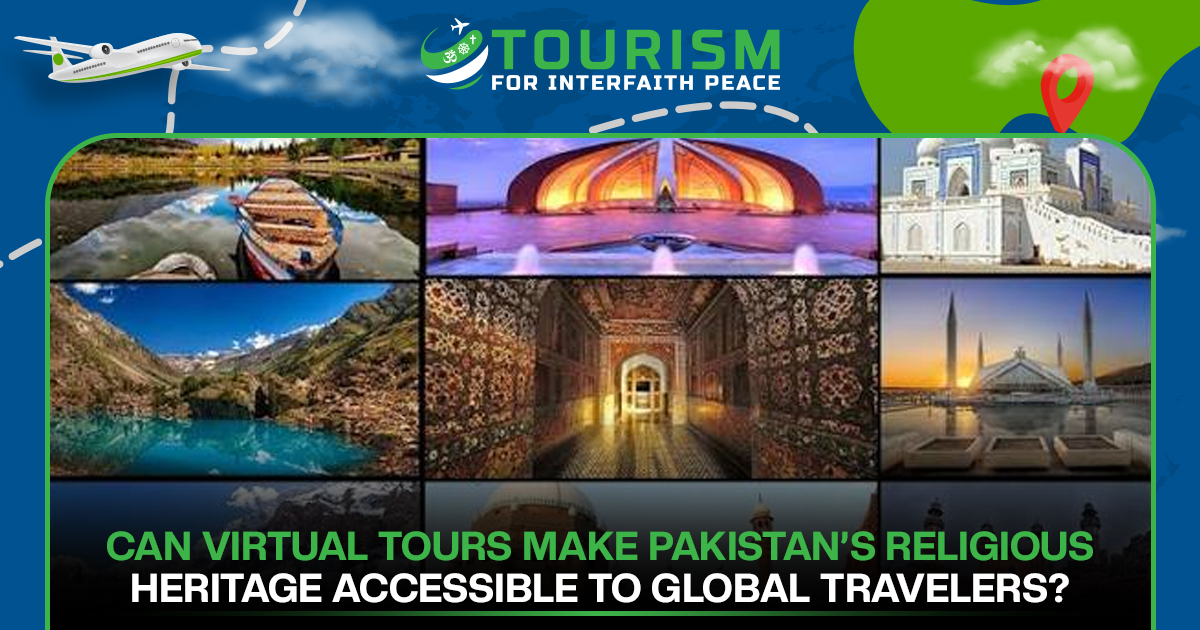
Virtual tours can meaningfully expand awareness of and access to Pakistan’s religious heritage for global audiences, but they work best as a complement to physical travel and professional preservation, not a substitute for either.
A traveler does not always need to cross a border to begin understanding another culture. Over the past decade, museums, archives and heritage organizations worldwide have built increasingly sophisticated virtual experiences — 360-degree walkthroughs, digitized archives, online exhibitions — that let people encounter places they may never physically reach. The question worth asking about Pakistan’s religious heritage is not whether virtual tours can replace a visit to a centuries-old shrine, gurdwara, temple or monastery. They cannot. The more useful question is whether they can create a genuine first point of connection for people who would otherwise never encounter these places at all.
Why Pakistan’s Religious Heritage Deserves a Wider Audience
Pakistan’s religious heritage reflects centuries of migration, pilgrimage, trade and settlement across a region that has long connected South Asia to Central Asia, Persia and beyond. Sites associated with Buddhist, Hindu, Sikh, Jain, Islamic and Christian traditions exist across the country, each carrying the memory of the communities who built, maintained and worshiped them. This is not simply a matter of architecture. A shrine’s carvings, a gurdwara’s oral traditions, a monastery’s ruins reflect how people moved, settled and encountered one another over long stretches of history. Much of this pattern traces back to Pakistan’s ancient travel routes, the corridors that carried merchants, pilgrims and scholars into contact with one another long before modern borders existed. Most international travelers have limited awareness of this depth, which is where digital access can play a meaningful role.
What Virtual Tours Can Offer That Physical Travel Cannot
A virtual tour removes several practical barriers at once. It reaches people who cannot travel because of cost, distance, visa restrictions, health or mobility limitations. It gives students and researchers a way to study a site’s layout without waiting for fieldwork funding, and diaspora communities a way to reconnect with places tied to family history. It also gives a first-time traveler researching a destination something more substantial than a photograph: a sense of scale, setting and atmosphere before committing to a journey.
None of this makes virtual access equivalent to physical presence. It does mean digital tools can introduce a heritage site to audiences who would otherwise never encounter it at all.
Virtual Access Is Not the Same as Virtual Understanding
A 360-degree video, on its own, does not teach history. Panning across a courtyard or a carved facade can be visually impressive without explaining who built the structure, what it meant to the community that used it, or how it fits into a larger regional story. A virtual tour that actually builds understanding needs historical context, accurate information, culturally informed interpretation, and ideally, the voices of the communities connected to the site rather than a purely external narration. Multilingual content matters here too, since much of the audience a virtual tour can reach will not read English as a first language. Without these elements, a virtual tour risks becoming an aesthetic experience rather than an educational one — visually interesting, but thin on the substance that actually builds cross-cultural understanding.
Can Digital Heritage Support Preservation?
Digital documentation has genuine value for heritage work: recording a site’s current condition, creating archives for researchers, supporting public education, and improving global visibility for places that receive little international attention. It is worth being precise about what this can and cannot do. Digitally documenting a site is not the same as physically conserving it. A high-resolution scan does not stop erosion, structural decay or environmental damage. What digital records can do is support the broader case for treating religious heritage as a shared cultural legacy — worth documenting, studying and protecting regardless of which community it originally belonged to.
From Virtual Curiosity to Responsible Travel
A realistic path runs from discovery to learning, understanding, planning, visiting and, ideally, engaging responsibly once there. Someone who first encounters a heritage site through a well-made virtual tour may become genuinely interested in visiting it. That interest is only valuable if it leads to responsible tourism: visits that respect religious practices, support local communities economically, and avoid treating a living place of worship as a mere backdrop. More tourism is not automatically a positive outcome; how it is conducted matters as much as whether it happens.
Can Virtual Tourism Contribute to Interfaith Peace?
This is where digital heritage intersects most directly with TIP’s work. A well-designed virtual experience can introduce someone to a tradition they know nothing about, replacing unfamiliarity with basic curiosity and, over time, assumption with actual learning. Shared heritage sites — places layered with the history of more than one community — can make that common ground visible in a way that abstract discussion often cannot. A virtual tour does not create peace by itself. It can function as one practical tool within a broader ecosystem that includes education, dialogue, preservation and tourism as a tool for peacebuilding, where understanding is built gradually rather than delivered instantly.
What a Better Virtual Heritage Experience Could Look Like
The strongest version of this idea combines 360-degree exploration with historical timelines, archival images, expert and community commentary, multilingual content, clear maps and architectural context, and practical information for travelers who want to plan a responsible visit afterward. Technology here is a tool for context, not a substitute for it.
The goal of virtual heritage should not be to replace travel. It should be to make understanding possible before travel, access possible without travel, and appreciation possible across borders. Used carefully, digital tools can help Pakistan’s religious heritage reach people who might never otherwise encounter it — and turn that first, distant glimpse into something closer to genuine understanding.