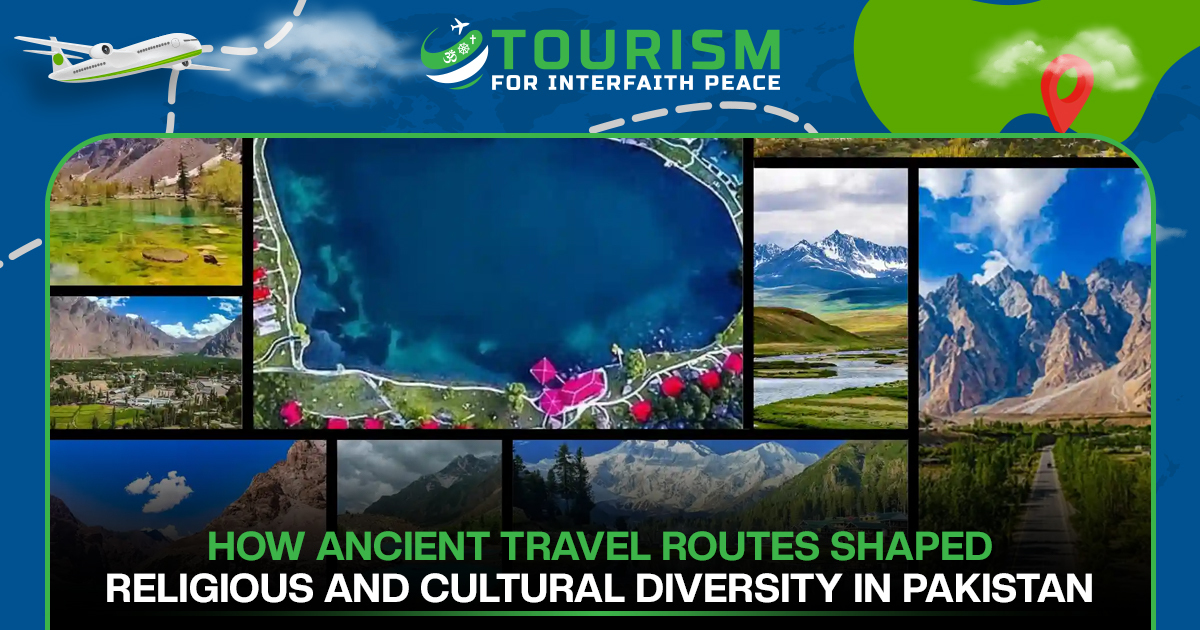
Long before modern borders divided South Asia, people moved across the region through interconnected roads, mountain passes, river valleys, and trading towns. Merchants carried silk, spices, and metalwork; monks and scholars carried manuscripts and ideas; artisans carried techniques from one workshop to the next. Present-day Pakistan sat at the meeting point of several major cultural worlds — South Asia, Central Asia, Persia, and, through them, the Mediterranean and China. Ancient travel routes in Pakistan did not simply move goods from one place to another; they moved people into contact with people, and it was this repeated contact, over many centuries, that helped shape the region’s extraordinary religious and cultural diversity.
Pakistan’s Geography Made It a Crossroads
The territory of modern Pakistan is defined by passages rather than boundaries. Mountain corridors through the northwest, including routes associated with the Khyber Pass, connected the Indus plains to Afghanistan and, beyond it, Central Asia. The Indus River and its tributaries offered a natural corridor southward toward the Arabian Sea, while the plains of Punjab linked the northwest to the rest of the subcontinent. Much of this movement later converged along the Grand Trunk Road, one of South Asia’s oldest continuously used routes. Armies used these same corridors, so the routes carried conflict as well as commerce — but their basic function endured: they pulled traders, pilgrims, scholars, and rulers through the region again and again, making sustained contact between distant cultures almost unavoidable.
Gandhara and the Movement of Buddhist Ideas
Few places illustrate this exchange as clearly as the ancient region of Gandhara, centered on the Peshawar valley and the area around Taxila in present-day Punjab. Archaeological evidence indicates that Taxila, known in antiquity as Takshashila, developed over roughly a millennium into one of the subcontinent’s most significant centers of urban life and learning, reaching particular prominence after the reign of the Mauryan emperor Ashoka and during the Kushan period. Successive rulers — Achaemenid Persian, Greek, Mauryan, Indo-Greek, Scythian, Parthian, and Kushan — passed through or governed the region, and each left a mark. The result, visible today across the eighteen archaeological sites of Taxila’s UNESCO World Heritage designation, was Gandharan art: Buddhist sculpture blending South Asian religious subject matter with the drapery and modeling techniques of the Hellenistic world. This was not one culture simply producing another; it was adaptation, built through generations of contact among monks, artisans, and merchants moving along shared routes.
The Silk Roads Were Networks of Cultural Exchange
The routes through Gandhara connected to the wider system historians call the Silk Roads — a term that, as UNESCO and Silk Road scholars emphasize, describes not a single road but a shifting network of overland and river routes linking East Asia, Central Asia, Persia, the Near East, and South Asia. Along these networks moved silk and spices, but also Buddhist manuscripts, artistic motifs, and craft techniques. Chinese Buddhist pilgrims such as Faxian and Xuanzang recorded journeys through Taxila and the wider Gandharan region on their way to and from India, evidence of how thoroughly the corridors of present-day Pakistan were woven into this larger web. Northern and northwestern Pakistan functioned as a hinge in that network, connecting South Asia to Afghanistan, Central Asia, and, through further relays, to Persia and China.
From Trade Routes to Religious Encounters
Religious diversity in Pakistan did not emerge from a single moment or route. Buddhism flourished in Gandhara for centuries, sustained by monasteries, teaching centers, and pilgrimage networks along the trade corridors. Hindu and Jain traditions had older roots in the region and continued to interact with these networks of movement. Centuries later, the Punjab these same corridors ran through became the birthplace of Sikhism in the fifteenth century, emerging from a distinct historical and spiritual context. Islam arrived through multiple, separate processes across several centuries — trade contact, conquest, migration, and the spread of Sufi teaching networks that themselves relied on established travel routes. These were not simultaneous or uniform developments, and historians caution against flattening them into a single narrative of harmony; the same corridors that carried scholars and pilgrims also carried armies and periods of real conflict. What the record does show is sustained, long-term contact between communities, out of which a genuinely diverse religious landscape gradually took shape.
Cultural Diversity Was Built Through Everyday Exchange
Beyond religion, these routes shaped everyday life. Languages absorbed vocabulary from Persian, Central Asian Turkic dialects, Arabic, and Sanskrit-derived tongues. Cuisines blended Central Asian, Persian, and South Asian ingredients and techniques. Architectural styles combined regional building traditions with influences carried in from Persia and Central Asia, while craft traditions, storytelling forms, and clothing styles developed through the same pattern of contact and adaptation. Cultural diversity, in other words, was rarely the product of one decisive event — it accumulated gradually, through generations of everyday interaction along shared roads.
What Ancient Routes Can Teach Us About Heritage Today
The heritage left behind by these routes is not only a matter of old monuments. It represents accumulated stories of movement, encounter, exchange, and coexistence — a record of how communities adapted to and learned from one another. Recognizing this history as religious heritage as a shared cultural legacy, rather than as the property of any single community, is central to understanding why sites like Taxila matter beyond their archaeological value.
Can Tourism Reconnect Communities With These Shared Histories?
Responsible heritage tourism offers one way to reconnect people with these interwoven histories — by visiting sites, learning local histories, meeting communities, and encountering perspectives different from one’s own. It does not create peace automatically. Tourism becomes meaningful only when it is respectful, community-centered, historically responsible, and educational — one part of a broader case for tourism as a practical tool for building peace between communities.
Preserving the Routes, Stories and Heritage
Preserving this history means preserving more than physical remains — oral traditions, archaeological evidence, religious sites belonging to multiple faiths, and the record of how communities once connected across long distances. Younger generations benefit from understanding that the diversity around them was not incidental; it was built, gradually, through centuries of human movement.
Ancient travelers could not have imagined today’s national borders, yet their journeys left cultural connections still visible across Pakistan. The task now is not to romanticize that past, but to learn what sustained curiosity and exchange can build — and to let responsible tourism help new generations rediscover these connections for themselves.
Frequently Asked Questions
How did ancient travel routes influence Pakistan’s cultural diversity?
Routes through the northwest and Punjab connected present-day Pakistan to Central Asia, Persia, and South Asia. Repeated contact along these corridors carried languages, art, food, and religious traditions into the region over many centuries, gradually building its layered cultural identity.
What role did the Silk Road play in Pakistan’s history?
Northern and northwestern Pakistan formed part of the wider Silk Roads network, a system of overland routes rather than a single path. This network linked Gandhara to Central Asia, Persia, and China, enabling the exchange of goods, Buddhist teachings, and artistic techniques.
Why is Taxila important to Pakistan’s religious heritage?
Taxila was a major center of Buddhist learning and a UNESCO World Heritage Site since 1980. Its ruins reflect successive Persian, Greek, Mauryan, Indo-Greek, and Kushan influences, illustrating centuries of cultural and religious interaction at a key regional crossroads.
How did trade routes contribute to religious exchange?
Merchant routes also carried monks, pilgrims, and scholars. Monasteries and teaching centers grew near trading towns, allowing Buddhist, Hindu, Jain, Sikh, and later Islamic traditions to develop and interact with one another over different historical periods.
Can heritage tourism help promote interfaith understanding?
Heritage tourism can support interfaith understanding when it is respectful, community-centered, and historically accurate. Visiting shared heritage sites and engaging with local communities helps people encounter histories and perspectives beyond their own, though tourism alone does not guarantee peace.