Travel changes you. Not just your passport stamps or your photo roll, but something quieter — the way you see other people’s lives, their rituals, their sense of the sacred. Anyone who has stood in a cathedral in Spain, watched the evening prayer call echo across Istanbul, or sat in the courtyard of a gurudwara on a cool morning knows this. Places of worship carry something. You feel it whether you share the faith or not.
Over time, the relationship between travel and religion has grown more layered. People have always journeyed to sacred places. But today, a different kind of journey is gaining ground — one that does not ask you to come with a fixed faith, but with an open mind.
That is the difference between religious tourism and interfaith tourism. They are related, but they are not the same thing.
Religious Tourism: The Journey of Devotion
Religious tourism is as old as human civilization itself. It is travel motivated by faith — visiting a sacred site, completing a pilgrimage, attending a religious event, or simply spending time in a place your faith considers holy.
A Muslim making Hajj to Mecca. A Hindu walking barefoot to Vaishno Devi. A Christian joining thousands in Rome for Easter. A Buddhist making the journey to Bodh Gaya, where the Buddha is said to have attained enlightenment. All of these are religious tourism in its purest form. The traveller arrives with devotion. The journey itself is an act of faith.
Religious tourism is deeply personal. It is not about comparison or curiosity about other belief systems. It is about going deeper into your own. The destination holds meaning because of what you already believe — and the journey reinforces that.
There is nothing narrow about this. For billions of people around the world, pilgrimage and sacred travel are among the most meaningful experiences of their lives. The spiritual weight of standing in a place your faith holds sacred cannot be overstated.
| Religious tourism takes you deeper into what you already believe. Interfaith tourism asks what you might learn from what someone else does. |
Interfaith Tourism: Travel as a Bridge
Interfaith tourism is newer in name, but the impulse behind it is ancient — the simple human instinct to understand how other people make sense of the world.
An interfaith traveller might visit a mosque, a synagogue, a church, and a temple all in the same trip — not to pray at each one in the same way, but to observe, to listen, to ask questions, and to find what is shared across what looks so different on the surface. They might attend an interfaith dialogue event, walk through a heritage site that holds significance for multiple religions, or spend time with communities whose daily life is shaped by a faith they have never encountered before.
The purpose is not spiritual in the devotional sense. It is something else — educational, yes, but also deeply human. It is about encountering the sacred through someone else’s eyes and coming back with a wider sense of what people value, how they pray, what they fear, and what they hope for.
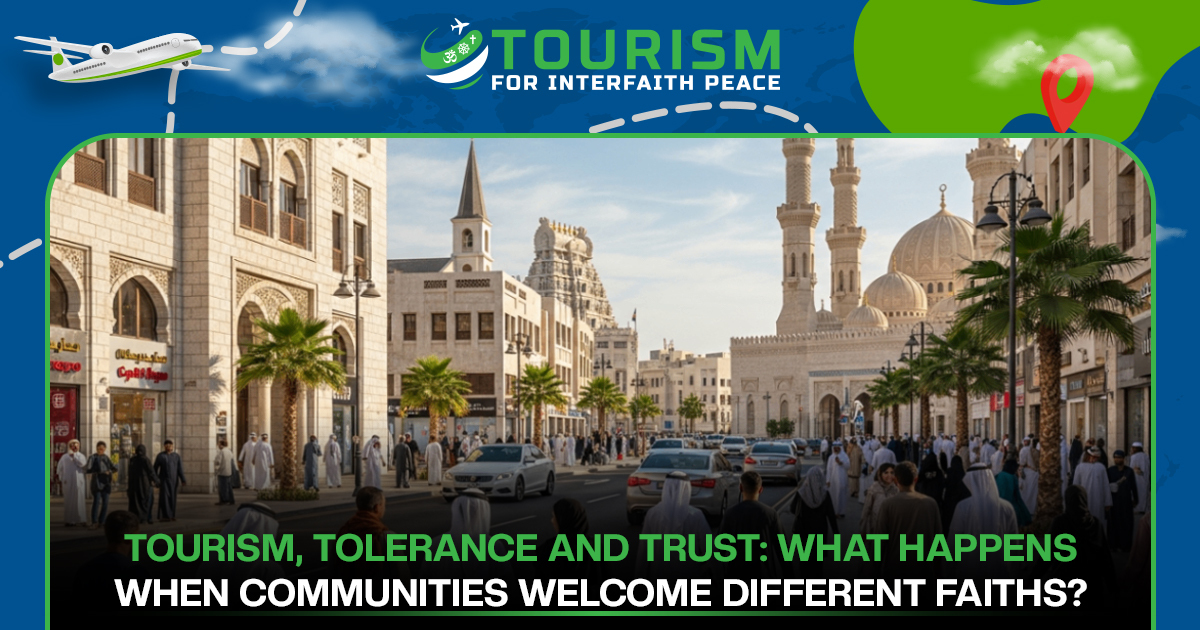
Think of a heritage city like Lahore, Jerusalem, or Cordoba. Each of these places carries the fingerprints of multiple religions — mosques beside churches, ancient temples beside shrines. An interfaith traveller does not rush past the buildings that do not belong to their faith. They slow down in all of them.
The Key Differences at a Glance
| Religious Tourism | Interfaith Tourism |
| Driven by personal faith and devotion | Driven by curiosity and desire for dialogue |
| Centres on one religion at a time | Explores multiple religions in one journey |
| Purpose is spiritual or devotional | Purpose is educational, cultural, peace-building |
| Pilgrimages, sacred site visits, rituals | Interfaith centres, multi-faith heritage sites, dialogue events |
| Deepens one’s own belief system | Broadens understanding of others’ beliefs |
Why Interfaith Tourism Matters in a Divided World
Much of the tension between communities today is built on ignorance rather than genuine conflict. People fear what they do not know. They misread rituals they have never seen, misunderstand beliefs they have never heard explained, and inherit suspicion from generations who never had the chance to sit across from someone different.
Interfaith tourism quietly dismantles that. When you walk into a place of worship that is not your own and someone welcomes you in, explains what is happening, and answers your questions without defensiveness — something shifts. You leave knowing more than you did. More importantly, you leave having seen a person, not a stereotype.
This is not a small thing. Peace between communities is not built in conference rooms alone. It is built in the ordinary moments of encounter — a shared meal, a guided walk through a heritage site, a conversation after a prayer service. Interfaith tourism creates those moments intentionally.
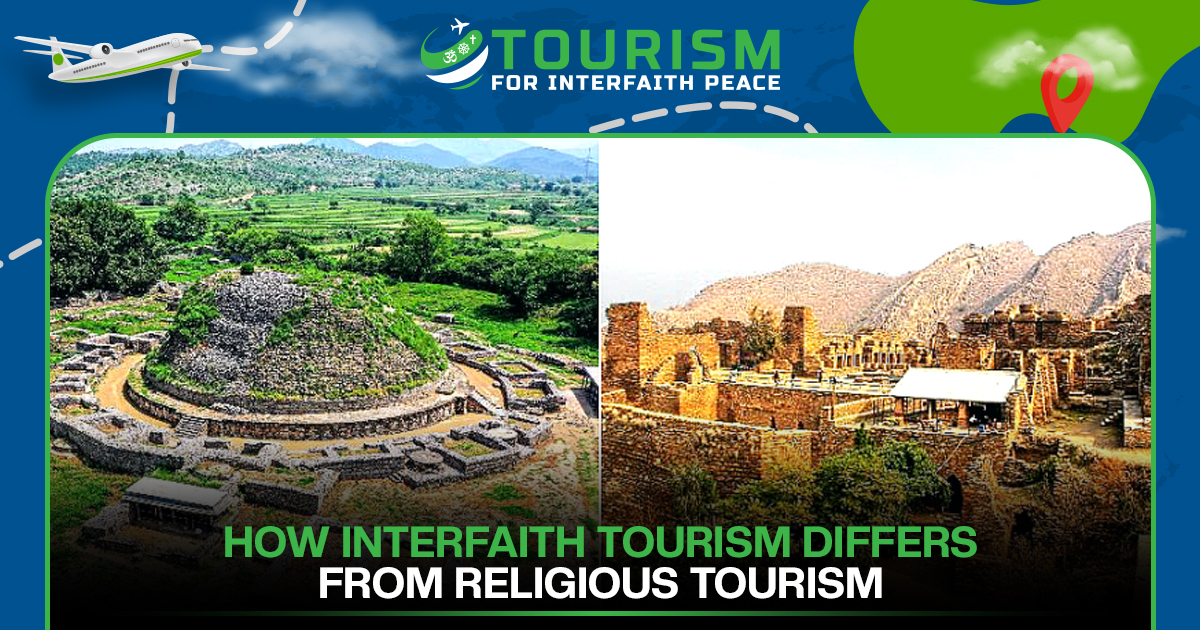
Countries like Pakistan, with their extraordinary layered religious and cultural history, have an enormous amount to offer interfaith travellers. Sufi shrines, ancient Buddhist sites, Hindu temples, Sikh gurudwaras, and centuries-old mosques all sit within the same geography. That is not a problem to manage. It is an asset — a living record of how different faiths have shared land and shaped each other across centuries.
Both Journeys Have Value
Religious tourism and interfaith tourism are not in competition. A person can make a pilgrimage with deep personal devotion and also travel with curiosity about how others experience the sacred. These are not contradictory instincts. They are both expressions of a search for meaning.
But interfaith tourism carries a particular responsibility in the present moment. In a world that finds so many reasons to divide along religious lines, travel that deliberately crosses those lines — with respect, with curiosity, with a willingness to sit in someone else’s sacred space and simply listen — is a quiet form of peacebuilding.
You do not have to share a belief to honour it. That is probably the most important thing interfaith tourism teaches. And it is a lesson that gets harder to unlearn once you have experienced it firsthand.