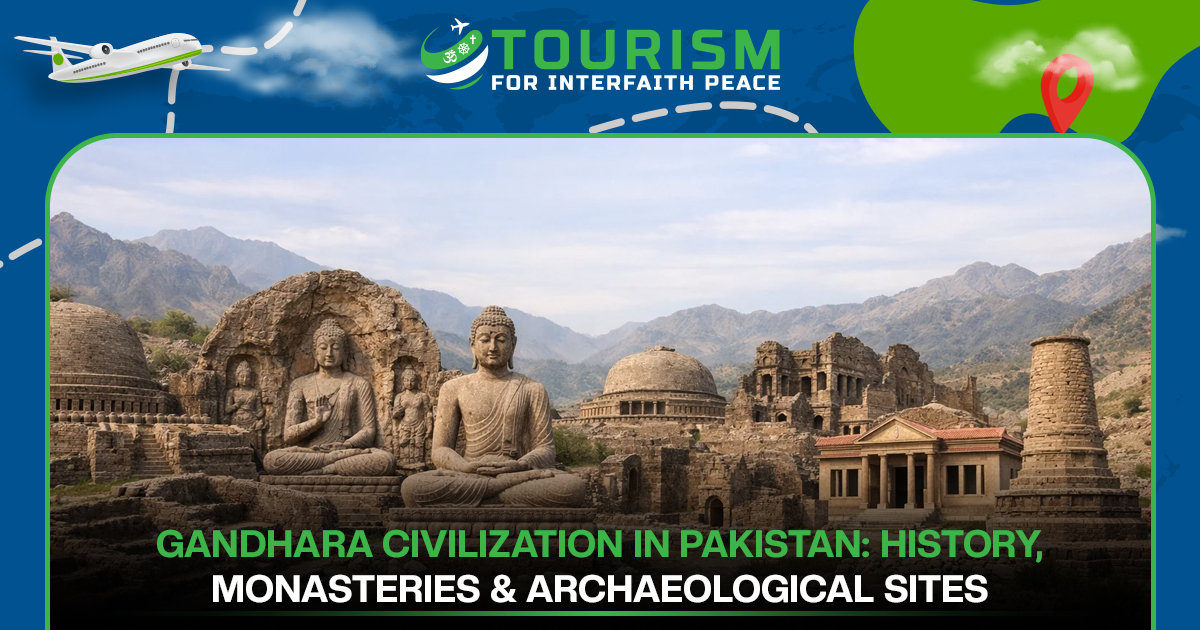
Some of the most amazing archeological finds in South Asia may be found in Pakistan. The Gandhara civilization has a unique place in world history among them. Ancient Gandhara, which is spread across sections of modern-day northern Pakistan and eastern Afghanistan, developed into a significant hub for Buddhist education, sculpture, architecture, and cross-cultural interaction.
The Gandhara culture in Pakistan provides important insights into centuries of religious and cultural evolution, from the ancient ruins of Taxila to the Buddhist monasteries of Takht-i-Bahi and Swat. These archeological sites now draw pilgrims, researchers, historians, and tourists eager to learn more about Pakistan’s ancient past.
What Was the Gandhara Civilization?
Gandhara was a historically significant area that stretched into sections of northern Pakistan and eastern Afghanistan and was centered around the Peshawar Valley. Its cultural influence persisted into the early medieval era, and its history began in the middle of the first millennium BCE.
Several strong dynasties had an impact on the area, including:
- Achaemenid Persians: established power in Gandhara politics.
- Mauryan Empire: The promotion of Buddhism was significantly aided by Emperor Ashoka.
- Indo-Greek Kingdoms: introduced the artistic and cultural influences of Hellenism.
- Kushan Empire: encouraged the growth of Gandharan art and Buddhist organizations.
Gandhara was a major hub for trade, scholarship, and cross-cultural exchange due to its location along historic trade routes that linked South and Central Asia.
The Connection Between Gandhara and Buddhism
Gandhara’s cultural development was significantly influenced by Buddhism. Buddhist temples, stupas, and educational institutions developed throughout the region under Emperor Ashoka and succeeding Kushan kings.
Gandhara developed into a popular travel destination for Buddhist pilgrims, monks, and intellectuals. Its creative traditions also aided in the expansion of Buddhist civilization throughout Asia.
The following are significant aspects of Gandharan Buddhist art:
- Sculptures of Bodhisattvas and Buddha.
- Reliefs made of stone that depict Buddha’s life experiences.
- Monasteries built for meditation and religious instruction.
- Stupas erected to honor and preserve Buddhist artifacts.
- Greco-Roman and South Asian artistic influences are combined.
Famous Gandhara Buddhist Sites in Pakistan
Many archeological artifacts connected to the Gandhara culture are preserved in Pakistan. These sites offer proof of prehistoric communities, Buddhist monasteries, and places of worship.
1. Taxila: An Ancient Centre of Learning
One of the most significant archeological sites connected to Gandhara is Taxila, which is situated in the Rawalpindi District of Punjab.
Originally called Takshashila, it became a significant hub for Buddhist study, trade, and education.
Three historic urban towns can be found in its archeological landscape:
- Bhir Mound: An early urban settlement.
- Sirkap: Hellenistic-inspired city that is fortified.
- Sirsukh: a settlement during the Kushan period.
Important Buddhist sites in Taxila include the Jaulian Monastery, Mohra Moradu Monastery, and Dharmarajika Stupa. Taxila, which was designated a UNESCO World Heritage Site in 1980, is still crucial to comprehending the history of ancient Gandharan.
2. Takht-i-Bahi: A Historic Buddhist Monastery
Takht-i-Bahi, one of Pakistan’s best-preserved Buddhist monastic complexes, is located in Khyber Pakhtunkhwa, close to Mardan.
The monastery was established in the early first century of the common era and continued to be operational until about the seventh century. Among its archeological remnants are:
Main stupa court.
- Votive stupa court.
- Monastic quadrangle.
- Meditation cells.
- Assembly areas and passageways.
The site’s 1980 UNESCO World Heritage designation is also linked to the neighboring archeological settlement of Sahr-i-Bahlol.
3. Swat Valley: The Buddhist Heritage of Uddiyana
Swat Valley was a significant hub for Buddhist education and religious activity and was historically connected to the ancient territory of Uddiyana.
Its archaeological landscape includes:
- Butkara Stupa: A significant Buddhist monument that was built in several stages.
- Saidu Sharif Stupa: proof of traditional Buddhist religious rituals.
- Shingardar Stupa: A historic Buddhist monument near Barikot.
- Udegram: an archeological site with artifacts from several historical eras.
These locations show how Swat influenced Buddhist customs and Gandharan art.
4. Pushkalavati: The Ancient City of Charsadda
Pushkalavati, a significant ancient city and political hub of Gandhara, is situated close to present-day Charsadda. Bala Hisar and Shaikhan Dheri are two of its archeological remnants.
Its proximity to significant river channels facilitated administration, trade, and cross-cultural interaction.
5. Ranigat: An Archaeological Treasure in Buner
Ranigat, a vast archeological site with Gandharan Buddhist roots, is situated in Buner District.
Stupas, monasteries, and other religious buildings are among its remnants. The site offers important insights into the building traditions of early Buddhist societies.
Important Gandhara Archaeological Sites at a Glance
| Site | Location | Historical Significance |
| Taxila | Rawalpindi, Punjab | Ancient settlements and Buddhist monasteries |
| Takht-i-Bahi | Mardan, KP | Buddhist monastic complex |
| Sahr-i-Bahlol | Near Takht-i-Bahi | Ancient fortified settlement |
| Butkara Stupa | Swat, KP | Buddhist religious monument |
| Pushkalavati | Charsadda, KP | Ancient political and urban centre |
| Ranigat | Buner, KP | Buddhist monastic remains |
Gandharan Art: A Fusion of Cultures
Gandhara’s unique artistic legacy was one of its finest achievements. Gandharan art blended Hellenistic and other local influences with religious themes from South Asia.
Its sculptures are known for their intricate ornamental elements, flowing robes, accurate facial features, and precise expressions.
Common characteristics include:
- Buddha sculptures with detailed facial features.
- Classical influences in clothing and artistic composition.
- Stone reliefs illustrating Buddhist stories.
- Decorative architectural elements and floral patterns.
An outstanding collection of Gandharan sculptures and archeological artifacts is kept in the Taxila Museum.
Exploring Gandhara Through Heritage Tourism
Gandhara’s archeological legacy presents substantial prospects for Pakistan’s cultural and religious tourist industry.
Discover the region’s role in world history while touring historic landscapes, Buddhist monasteries, museums, and old settlements.
Heritage tourism can support this legacy through:
- Educational tourism: motivating scholars and students to investigate ancient history.
- Religious tourism: welcoming pilgrims who practice Buddhism and are interested in ancient sacred locations.
- Cultural exchange: Connecting international visitors with local communities.
- Economic development: supporting regional tour guides, craftspeople, and lodging establishments.
- Heritage conservation: Promoting awareness and responsible preservation.
Travel Tips for Visiting Gandhara Archaeological Sites
For a meaningful visit, travelers should:
- For more comfortable outdoor exploring, go in the spring or fall.
- Combine neighboring attractions, including the museums and archeological sites in Taxila.
- To comprehend the historical background, hire informed local guides.
- Verify security instructions, travel plans, and opening hours.
- Refrain from handling, removing, or causing harm to archeological artifacts.
- Maintain the cleanliness of historical sites and show consideration for the surrounding communities.
FAQ
- What was the Gandhara civilization?
Parts of what is now northern Pakistan and eastern Afghanistan were part of the ancient cultural and historical region known as Gandhara. It gained notoriety for Buddhist education, sculpture, architecture, and cross-cultural interactions.
- Where are the archaeological remains of Gandhara located?
Taxila, Swat, Peshawar, Mardan, Charsadda, and Buner are home to significant archeological ruins. Taxila, Takht-i-Bahi, Butkara Stupa, and Ranigat are significant locations.
- What is the connection between Gandhara and Buddhism?
Gandhara developed into a significant hub for Buddhist scholarship, monasteries, stupas, and artistic advancement. Its customs helped Buddhism spread throughout Central Asia and other regions of Asia.
- Why is Taxila important in Gandhara history?
In the past, Taxila was a hub for Buddhist study, trade, and education. Settlements, stupas, and monasteries are among the several historical eras represented by its archeological remnants.
- What is Gandharan art famous for?
Gandharan art is renowned for fusing Hellenistic artistic elements with South Asian religious themes, especially in Buddha sculptures and stone reliefs.